Benchmark English Translations of Baltasar Gracian's "The Art of Worldly Wisdom"English translations of Baltasar Gracian's "The Art of Worldly Wisdom" generally considered to be the "benchmark" translations are that of Joseph Jacobs (1892); Martin Fischer (1934) and Christopher Maurer (1991). These translations are generally still found on book store shelves. However, it is a pity the excellent 1953 translation of L.B. Walton (of the University of Edinburgh) did not get a wider distribution. The Lawrence C. Lockley 1967 translation is a good scholarly effort. All found translations are included below so people can peruse for themselves, especially comparing the word selection and overall theme of the Maxims (some Maxims may not be accurately matched due to some translations bearing no apparant match to the others). The translation I consider the best would be the Joseph Jacobs (1892), but this could be due to it being the first translation I read. Though a recently obtained L.B. Walton 1953 scholarly translation is also very excellent (with a first class introduction). Be wary that some anonymous editors have dumbed down the original Jacobs text in some recent third party reprints without indicated this has occured (both in the text and the notes explaining the caveates and limitations of the translation); and to a lesser extent in some third party reprints of the Fischer 1934 text.Pretty much all the translations have a charm that makes them worth perusing; though it would be recommended to use the Joseph Jacobs (1892) or L.B. Walton (1953) as the control standard for comparison. While the earlier Anonymous (1685) and Mr Savage (1702) would be roughly contemporary with the original Spanish text, there are statements by later translaters that the 1702 translation was translated from the 1685 French translation by De La Houssaie, not the original Spanish text. ("L'Homme De Cour", Par le Sieur Amelot de la Houssaie, 1685). Though L.B. Walton states that Mr Savage (1702) "had, some happy inspirations". The 1685 Anonymous translation is similar to the 1702, but does have quite distinct differences and does not have the translated commentry of Sieur Amelot de la Houssaie. People may like to read Professor Frank Pajares's page on Why provide a new translation of Baltasar Gracián's Oráculo Manual y Arte de Prudencia and the start of his translation
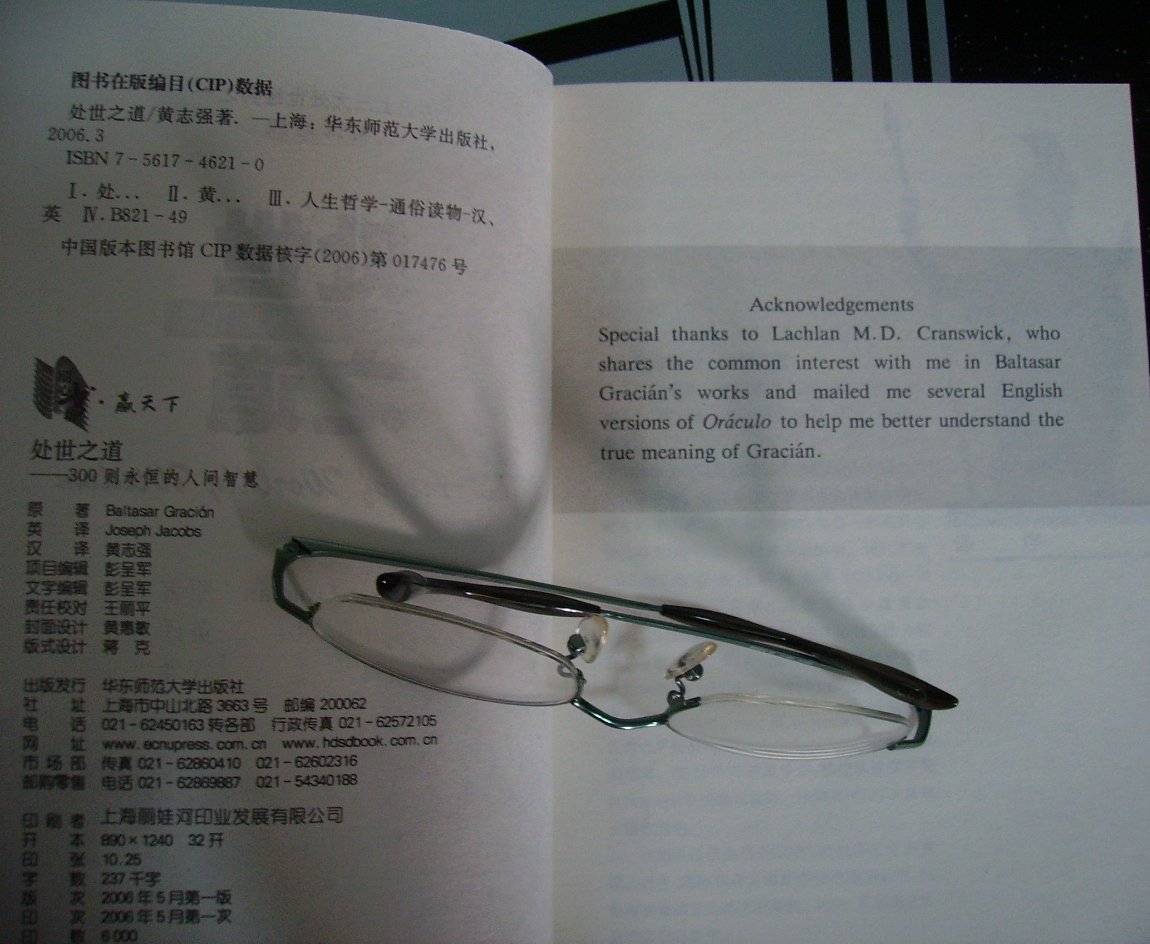
A suggestion for people interested in other European language translations may be to check the Bibliographic Appendix to Martin Fischer's 1934 translation, and that in the L.B. Walton 1953 translation. Even though written in the 1930's and 1950's respectively, it may serve as a guide, especially for the German and French version. Until May 2006, there was a single Chinese language translation. But it is a translation of the Maurer 1991 English translation. Feedback received from one person who read it, and compared it to the Maurer text, gave a very negative review as to the quality and consistency of the translation. However, there is a newer May 2006 bilingual English-Chinese translation, based on using several of the English texts, by Hadrian Huang in Shanghai, ISBN is 7-5617-4621-0 (http://www.hdsdbook.com.cn/). It provides the English 1892 translation by Joseph Jacobs with the new Chinese translation. Screen dumps of the book cover and acknowledgements is below: Via Rastislav Telgarsky: a Polish translation is "Brewiarz Dyplomatyczny"; in English: Diplomatic Breviary (or, a "Reading for Diplomats") and in Slovak: Baltasar Gracian, Prirucne Orakulum Mudrosti, NESTOR, Bratislava 1998. (From Spanish original Oraculo manual y arte de prudencia, Catedra, Madrid, translated by PhDr. Martina Slezakova)
|
Comparing some maxims within the different English translations of Baltasar Gracian, and the original Spanish and 1685 French translation
Maxim/Aphorism No 9 by Baltasar Gracian
Maxim/Aphorism No IX/9 by Baltasar Gracian - de la edición de Huesca, Juan Nogués, 1647([Nota preliminar: Edición digital a partir de la edición de Huesca, Juan Nogués, 1647 y cotejada con la edición crítica de Emilio Blanco (Madrid, Cátedra, 1997).])Desmentir los achaques de su nación: Participa el agua las calidades buenas o malas de las venas por donde passa, y el hombre las del clima donde nace. Deven más unos que otros a sus patrias, que cupo allí más favorable el Cenid. No ai nación que se escape de algún original defecto: aun las más cultas, que luego censuran los confinantes, o para cautela, o para consuelo. Vitoriosa destreza corregir, o por lo menos desmentir estos nacionales desdoros: consíguese el plausible crédito de único entre los suyos, que lo que menos se esperava se estimó más. Ai también achaques de la prosapia, del estado, del empleo y de la edad, que si coinciden todos en un sugeto y con la atención no se previenen, hazen un monstro intolerable.
Maxim/Aphorism No IX/9 by Baltasar Gracian (Page 8-9) - L'Homme de Cour de Baltazar Gracian, 1685 (French translation of the Art of Worldly Wisdom)(Traduit & commente. Par le Sieur Amelot de la Houssaie, ci-devant Secretaire de l'Ambassade de France a Venise. Troisieme Edition, revue and corigee. A Paris. Chez la Veuve-Martin, and Jean Boudot, rue Saint Jaques, au Soliel d'or. M. DC. LXXXV (1685) Avec Priviledge du Roi)Démentir les défauts de sa nation: L'eau prend les bonnes ou mauvaises qualitez des mines, par où elle passe, & l'homme celles du climat, où il naît. Les uns doivent plus que les autres à leur Patrie, pour y avoir rencontré une plus favorable étoile. Il n'y a point de nation, si polie qu'elle soit, qui n'ait quolque défaut original, que censurent ses voisins, soit par précaution, ou par émulation. C'est une victoire d'habile-homme, de coriger, ou du moins de faire mentir là censure de ces défauts. o'on aquert par la le renom glorieux d'être unique, & céte éxemtion du défaut commun est d'autant plus estimée, que personne ne s'y atend. Il y a aussi des défauts de famille, de profession, d'emploi, & d'age, qui venant à se trouver tous dans un même sujet, en font un monstre insuportable, si l'on ne les prévient de bonne-heure.
Maxim/Aphorism No IX/9 by Baltasar Gracian (Page 7) - translated (1685) by Anonymous(The Courtiers Manual Oracle: or, the Art of Prudence. Written Originally in Spanish by Balthazar Gracian. And now done in English. London: Printed for M. Flesher, for Abel Swalle, at the Sign of the Unicorn, at the Sign of the Unicorn, at the West-End of St Pauls. 1685: (Thanks to Dr. Georges T. Dodds of McGill University for lending me a PDF copy of this version))To falsisie the Defects in one's Nation: Water imbibes the good or bad qualities of the Minerals through which it passes, and Man those of the Climates where he is born. Some are more obliged than others to their Country, in that they have met with a more favourable constallation in it. There is no Nation, how Polite foever, but hath some original failing, which their Neighbours, either out of caution or emulation, censure. It is the victory of an able Man to correct, or at least to nely the censure of there failings. Thereby one acquires glorious renown of being singular, and that exemption from a common Fault is the more esteemed, that no body expects it. There are also Family-defects, defects in Profession, Employment and Age, which concurring altogether in one and the same subject, render it an unsupportable Monster, if they be not timely prevented.
Maxim/Aphorism No IX/9 by Baltasar Gracian (Page 11) - translated (1702) by Mr Savage(The Art of Prudence: or, a Companion for a Man of Sense. Written originally in Spanish by that Celebrated Author Balthazar Gracian; now made English from the best Edition of the Original, and Illustrated with the Sieur Amelot de la Houssaie's Notes by Mr. Savage. London: Printed for Daniel Brown, without Temple Bar; J. Walthoe, in the Middle Temple Cloysters; and T. Benskin, at Lincolns-Inn Back-Gate)To conceal the Defects in one's Nation: Water imbibes the good or bad Qualities of the Minerals thro' which it passes, as a Man does those of the Climate under which he is born. Some are more obliged than others to their Country, in that they have met with a more favourable Constallation in it. There is no Nation, how polite soever, but hath some original Failing, which its Neighbours, either out of Caution or Emulation, censure. It is the Glory of the able Man to correct, or at least to battle the Censure of these Failings. Thereby one acquires great Renown, and that Exemption from a common Fault is the more esteemed, in that no body expected it. There are also Family-Infirmities, Defects in Professions, Employments, and Age; which meeting altogether in one, and the same subject, render it an insupportable Monster, if they be not timely prevented.
Maxim/Aphorism No 9 by Baltasar Gracian - from the partial translation (1877) of Mr. (now Sir Mountstuart) Grant Duff (article on Balthasar Gracian in the Fortnightly Review of March 1877, VOL. XXI. N.S., page 228 - 342)9. Avoid the faults of your nation. - Water shares in the good or bad qualities of the veins through which it passes, and a man in those of the clime in which he is born. . . . There are family faults and faults of position, faults of office and faults of age. If they all meet in one person, and are not opposed by attention, they make an intolerable monster.
Maxim/Aphorism No 9 by Baltasar Gracian - adapted from the translation (1892) of Joseph Jacobs (1856-1916) (The Art of Worldy Wisdom by Baltasar Gracian.)9. Avoid the faults of your nation. Water shares the good or bad qualities of the strata through which it flows and man those of the climate in which he is born. Some owe more than others to their native land, because there is a more favorable sky in the zenith. There is not a nation among even the most civilized that has not some fault peculiar to itself which other nations blame by way of boast or as a warning. 'Tis a triumph of cleverness to correct in oneself such national failings, or even to hide them : you get great credit for being unique among your fellows, and as it is less expected of you it is esteemed the more. There are also family failings as well as faults of position, of office, or of age. If these all meet in one person and are not carefully guarded against, they make an intolerable monster. ---- [from the Shambhala pocket classic adapted from the translation of Joseph Jacobs, ISBN: 0-87773-921-8, 2000 Edition - anonymous editorial changes made to the text in bold. In the 1993 pocket edition the anonymous editor mentions the Shambala edition was updated where necessary (due to dated syntax or grammar), by comparision with the Fischer (1934), Walton (1953) and Maurer (1992) versions.] 9. Avoid the faults of your nation. Water shares the good or bad qualities of the channels through which it flows and people share those of the climate in which they are born. Some owe more than others to their native land, because there is a more favorable sky in the zenith. There is not a nation among even the most civilized that has not some fault peculiar to itself that other nations blame by way of boast or as a warning. It is a triumph of cleverness to correct in oneself such failings, or even to hide them. You get great credit for being unique among your fellows because what is less expected is esteemed all the more. There are also family failings as well as faults of position, of office, or of age. If these all meet in one person and are not carefully guarded against, they make an intolerable monster.
Maxim/Aphorism No 9 by Baltasar Gracian - translated (1934) by Martin Fischer (The Art of Worldy Wisdom by Baltasar Gracian; Charles C. Thomas Publisher, Springfield, Illinois)Belie in yourself the weaknesses of your country. Water partakes of the qualities, good or bad, of the seams through which it flows; the man of the clime into which he is born. Some owe more to their country than other because a happier zenith lay above them. There is not nation, even of the most cultured, without some inborn defect which its neighbors will not at once strike upon, either for their caution, or their comfort. A commendable skill to eradicate such national weaknesses in yourself, or at least, to hide them: thus are you made unique among your kind, for what is least expected is most esteemed. There are weaknesses also of race, of rank, of profession, and of age, which if gathered together in one individual, and not curbed, yield an intolerable monster.
Maxim/Aphorism No 9 by Baltasar Gracian - from "Gracian: A Selection of Wise, Witty, Moral and Satyrical Maxims, Pluck'd from the writings of the Spanish Philosopher and Monk - Baltasar Gracian Y Morales (1601-1658)" - 1938 - Printed for the Entertainment of the Friends of Dr. C. Charles Burlingame : New York and Hartford M. CM. XXXVIII[not present in the translation]
Maxim/Aphorism No 9 by Baltasar Gracian - from "Again Gracian - A Selection of maxims dealing with interpersonal relationships" - December 1945 - Privately Printed for Dr. C. Charles Burlingame: Hartford: Boston: New York: M. CM. XLV[not present in the translation]
Maxim/Aphorism No 9 by Baltasar Gracian - from the 1947 translation of Otto Eisenschiml (1880-1963) - page 5, Essential Books, Duell, Sloan and Pearce - New YorkMan inherits some of the good and some of the bad qualities of his forefathers, like water which carried with it varying traces of the soil through which it has passed on its way to the surface. But, unlike the water which cannot purify itself, man can free himself of his inherited handicaps. He will thus not only benefit himself, but his brothers as well, especially if the vices ascribed to them are based on fixed prejudices and exist largely in the imagination of malicious revilers.
Maxim/Aphorism No 9 by Baltasar Gracian - from the translation of L.B. Walton (1953) - page 55, The Oracle: A Manual of the Art of Discretion by Baltasar Gracian, translated by L.B. Walton: London, J.M. Dent and Sons Ltd.("Where a more of less literal rendering of the Spanish has been found possible, words which, although they do not have their counterpart in the Spanish text, are necessary in English to bring out the full sense of the original, appear in square brackets.")Conceal your national failings. Water shared the good or bad qualities of the channels through which it flows, and a man the characteristics of the country in which he is born. Some owe more than others to their fatherland, for the stars have been more favourable inclined towards them there [than they would have been in another part of the world]. There is no nation, however civilized, that is free from some native failing which its neighbours are quick to censure, either from guile, or for their own amusement. It is a triumph of skill to correct or, at least, to conceal these national shortcomings; to do so will win you the praiseworthy reputation of being unique among your fellows: for what was least expected is the more highly esteemed. There are, also, defects of lineage, status, office, and age, which, if they are all united in one person and are not carefully forestalled, make an insufferable monster.
Maxim/Aphorism No 9 by Baltasar Gracian - from the translation of Thomas G. Corvan (1964) - page XX, Philosophical Library Inc, New York: Library of Congress Card Number: 64-14415[Can't match this up]
Maxim/Aphorism No 9 by Baltasar Gracian - translated (1966) by Lawrence C. Lockley ( The Science of Success and the Art of Prudence, University of Santa Clara Press, Copyright 1967)Live down the faults of your race. Water shares the good and the bad qualities of the strata through which it passes, and man, those of the culture into which he is born. Some owe more than others to their fatherlands, for in some places the sky seems more propitious for accomplishment. Not even the most civilized races escape faults. It is a triumph of cleverness to correct, or at least, to conceal, these racial failings. You can achieve credit by this tactic, the more because it is not expected of you. There are also faults of the generation, of the country, of the occupation, and of the era. If these all meet in one person, he will, unless he guards well against them, grow to be a veritable monster.
Maxim/Aphorism No 9 by Baltasar Gracian - adapted from the translation (1991) of Christopher Maurer (The Art of Worldy Wisdom by Baltasar Gracian, from DoubleDay, ISBN: 0-385-42131-1; 1992)Avoid the defects of your country. Water shares the good and bad qualities of the beds through which it runs; people share those of the region where they are born. Some owe more than others to their mother country, or city, for they were born under favourable skies. No country, not even the most refined, has ever escaped some innate defect or other, and these weaknesses are seized on by neighboring countries as defense or consolation. It is a triumph to correct, or at least dissimulate, such national faults. By doing so, you will be revered as unique among your people; for what is least expected is most valued. Other defects are caused by one's lineage, condition, occupation and by the times. If all these defects come together in one person, and no care is taken to foresee and correct them, they produce an intolerable monster.
Maxim/Aphorism No 9 by Baltasar Gracian - from the book, "Practical wisdom for perilous times : selected maxims of Baltasar Gracian" adapted and edited by J. Leonard Kaye; Pocket Books; 1992, ISBN: 0-671-79659-3(Lachlan's Note: J. Leonard Kaye's book states that its "Alphorisms are adapted from A Truthtelling Manual and the Art of Worldly Wisdom: Being a collection of the aphorisms which appear in the works of Baltasar Gracian, immediately translated for the understanding from a 1653 Spanish Text by Martin Fisher.) [Can't match this up]
Maxim/Aphorism No 9 by Baltasar Gracian - from the book, "The Manual of Prudence: 400 years of worldly wisdom" translated by Juan de Aragon - language consultant: Judy Bar-on; Astrolog Publishing House; 2004, ISBN: 965-494-194-5You are not your country Water must take on the forms, good and bad, of the vessels which contain it. Man assumes the conditions into which he is born. There are those born under a lucky star that receive much benefit from their native country; but no nation, even the most advanced, is without some element which is chosen by its neighbors as the reason for a strike against it either in self defense or for their own gain. It is desirable to erase national weakness from your person, or at least to cover them up. This will hold you apart, since that which is not expected is held in high esteem. The same holds true for attributes of your race, rank, profession, or age, which if you do not contain them can turn into a dreadful monstrosity. Reject, therefore, the aspect of your group or nationality which work against you.
Maxim/Aphorism No 9 by Baltasar Gracian - from "Oráculo Manual i Arte de Prudencia" translated by Professor Frank Pajares; 2005, (published on the web)Avoiding your nation's defects. Water shares the good or bad qualities of the earth through which it passes, and man of the climate into which he is born. Some owe more than others to their nation, they were born under clearer skies. Not even the most cultured of nations can avoid an innate defect, which other nations quickly criticize, either for caution or for consolation. It is a triumph of skill to correct, or at least to overlook, these national faults: you will be thought unique among your countrymen, for what is least is expected is most valued. There are defects also due to ancestry, to condition, to occupation, and to age, which if they come together in one person and with attention are not prevented, create an intolerable monster. |
Maxim/Aphorism No 13 by Baltasar Gracian
Maxim/Aphorism NoXIII/13 by Baltasar Gracian - de la edición de Huesca, Juan Nogués, 1647([Nota preliminar: Edición digital a partir de la edición de Huesca, Juan Nogués, 1647 y cotejada con la edición crítica de Emilio Blanco (Madrid, Cátedra, 1997).])Obrar de intención, ya segunda, y ya primera Milicia es la vida del hombre contra la malicia del hombre, pelea la sagazidad con estratagemas de intención. Nunca obra lo que indica, apunta, sí, para deslumbrar; amaga al aire con destreza y executa en la impensada realidad, atenta siempre a desmentir. Echa una intención para assegurarse de la émula atención, y rebuelve luego contra ella venciendo por lo impensado. Pero la penetrante inteligencia la previene con atenciones, la azecha con reflexas, entiende siempre lo contrario de lo que quiere que entienda, y conoce luego qualquier intentar de falso; dexa passar toda primera intención, y está en espera a la segunda y aun a la tercera. Augméntase la simulación al ver alcançado su artificio, y pretende engañar con la misma verdad: muda de juego por mudar de treta, y haze artificio del no artificio, fundando su astucia en la mayor candidez. Acude la observación intendiendo su perspicacia, y descubre las tinieblas revestidas de la luz; desçifra la intención, más solapada quanto más sencilla. Desta suerte combaten la calidez de Pitón contra la candidez de los penetrantes rayos de Apolo.
Maxim/Aphorism No XIII/13 by Baltasar Gracian (Page 8-9) - L'Homme de Cour de Baltazar Gracian, 1685 (French translation of the Art of Worldly Wisdom)(Traduit & commente. Par le Sieur Amelot de la Houssaie, ci-devant Secretaire de l'Ambassade de France a Venise. Troisieme Edition, revue and corigee. A Paris. Chez la Veuve-Martin, and Jean Boudot, rue Saint Jaques, au Soliel d'or. M. DC. LXXXV (1685) Avec Priviledge du Roi)Procéder quelquefois finement, quelque-fois rondement Le Vie-Humaine est un combat contre le malice de l'homme même. L'homme adroit y emploie pour armes les stratagemes de l'intention. Il ne fait jamais ce qu'il montre avoir envie de faire, il mire un but, meis c'est pour tromper les yeux, qui le regardent. Il jete une parole en l'air, & puis il fait une chose, à quoi personne ne pensoit. S'il dit un mot, c'est pour amuser ;'atention de ses rivaux; & des Qu'élle est ocupee à ce qu'ils pensent, il éxécute aussi-tôt ce qu'ils ne pensoient pas. Celui donc, qui veut se garder d'étre trompé, prévient la ruse de son compagnon par de bonnes réfléxions. Il entend toujours le contraire de ce qu'on veut, qu'il enterde, &, par là, il découvre incontinent la feinte. Il laisse passer le premier coup, pour atendre de pié-ferme le second, ou le troi-fieme. Et puis, quant son artifice est connu, il resine sa dissimulation, en se sevent de la vérité même, pour tromper. Il change de jeu & de baterie, pour changer de ruse. Sone artifice est de n'en avoir plus, & toute sa finesse est de passer de la dessimulation précédente a la candeur. Celui, qui l'observe, & qui à de la pénétration, connoissant l'adresse de son rival, se tient sur fes gardes, & découvre les tenébres revétuës de la lumiére. Il déchifre un procédé d'autant plus caché, que tout y est sincére. Et c'est ainsi que la finesse de Piton combat contre la candeur d'Apollon.
Maxim/Aphorism No XIII/13 by Baltasar Gracian (Page 10-11) - translated (1685) by Anonymous(The Courtiers Manual Oracle: or, the Art of Prudence. Written Originally in Spanish by Balthazar Gracian. And now done in English. London: Printed for M. Flesher, for Abel Swalle, at the Sign of the Unicorn, at the Sign of the Unicorn, at the West-End of St Pauls. 1685: (Thanks to Dr. Georges T. Dodds of McGill University for lending me a PDF copy of this version))To proceed sometimes cunningly, sometimes candidly. Man's life is a conflict with the malice of man himself. An expert man for weapons uses the strategems of intention. He never does what he seems to have a mind to doe. He takes aim, but that is to deceive the Eyes that look upon him. He blurts out a word in the air, and then does a thing that no body dreamt of. If he comes out with a saying, it is to amuse the attention of his Rivals, and whilst that is taken up in considering what he drives at, he presently acts what never came into their thoughts. He then, that takes heed not to be imposed upon, prevents the cunning of his Companion by good reflexions. He always understands the contrary of what one would have him to understand, and thereby he immediates discovers the falsisie. He lets the first pass goe, and expects the second or third with a good guard. And when afterwards his Artifice is known, he refines his dissimulation, making use of truth it self to deceive by. To change his cunning, he changes his ground and battery. His Artifice is to have no more Art, and all is subtilty is to pass from Dissimulation to Candour. He, who observes it with a piercing Eye, knowing the Arts of his Rival, stands upon his guard, and discovers darkness under a veil of light. He unriddles a procedure, the more mysterious, that every thing in it is sincere. And thus the wiles of Pytho engage the candour of Apollo.
Maxim/Aphorism No XIII/13 by Baltasar Gracian (Page 11) - translated (1702) by Mr Savage(The Art of Prudence: or, a Companion for a Man of Sense. Written originally in Spanish by that Celebrated Author Balthazar Gracian; now made English from the best Edition of the Original, and Illustrated with the Sieur Amelot de la Houssaie's Notes by Mr. Savage. London: Printed for Daniel Brown, without Temple Bar; J. Walthoe, in the Middle Temple Cloysters; and T. Benskin, at Lincolns-Inn Back-Gate)To proceed sometimes cunningly, sometimes candidly. Man's life is a perpetual Conflict with Man himself. An expert Person uses for Weapons the strategems of Intention: He never does what he seems to have a mind to do. He takes aim, 'tis true, but that only to deceive the Eyes of those that look upon him. He blurts out a word, and afterwards does what no body dreamt of. If he comes out with a Saying, it whilst they are taken up in considering what he drives at, he presently Acts, what never came into their Thoughts. He then, what takes heed not to be imposed upon, prevents the cunning of his Companion, by good Reflections. He always understands the contrary, of what one would have him, and thereby immediately discovers the stratagem. He parrys with first Pass, and expects the second, or third, in a good guard. And when afterwards his Artifice comes to be known, he refines his dissimulation, making use of Truth her self to deceive by. To change his cunning, he changes his ground and Battery. His Artifice is to have no more Art, and all his subtility is to pass from Dissimulation to Candour. He, who observes with a piercing Eye, knows the Arts of his Rival, stands upon his guard, and discovers darkness thro a veil of light. He unriddles a procedure, which is the more mysterious, in that every thing in it is sincere. And thus the wiles of Python combats the candour of Apollo.
Maxim/Aphorism No 13 by Baltasar Gracian - from the partial translation (1877) of Mr. (now Sir Mountstuart) Grant Duff (article on Balthasar Gracian in the Fortnightly Review of March 1877, VOL. XXI. N.S., page 228 - 342)[this maxim was not translated]
Maxim/Aphorism No 13 by Baltasar Gracian - adapted from the translation (1892) of Joseph Jacobs (1856-1916) (The Art of Worldy Wisdom by Baltasar Gracian.)13: Act sometimes on second thoughts, sometimes on first impulse. Man's life is a warfare against the malice of men. Sagacity fights with strategic changes of intention : it never doing what it threatens, it aims only at escaping notice. It aims in the air with dexterity and strikes home in an unexpected direction, always seeking to conceal its game. It lets a purpose appear in order to attract the opponent's attention, but then turns round and conquers by the unexpected. But a penetrating intelligence anticipates this by watchfulness and lurks in ambush. It always understands the opposite of what the opponent wishes it to understand, and recognizes every feint of guile. It lets the first impulse pass by and waits for the second, or even the third. Sagacity now rises to higher flights on seeing its artifice foreseen: It tries to deceive by truth itself, changes its game in order to change its deceit, cheats by not cheating, and founds deception on the greatest candour. But the opposing intelligence is on guard with increased watchfulness and discovers the darkness concealed by the light and deciphers every move, the more subtle because more simple. In this way the guile of the Python combats the far darting rays of Apollo. ---- [from the Shambhala pocket classic adapted from the translation of Joseph Jacobs, ISBN: 0-87773-921-8, 2000 Edition - anonymous editorial changes made to the text in bold. In the 1993 pocket edition the anonymous editor mentions the Shambala edition was updated where necessary (due to dated syntax or grammar), by comparision with the Fischer (1934), Walton (1953) and Maurer (1992) versions.] Act sometimes on second thoughts, sometimes on first impulse. Life is a warfare against the malice of others. Sagacity fights with strategic changes of intention - never doing what it threatens, aiming only to escape notice. It aims in the air with dexterity and strikes home in an unexpected direction, always seeking to conceal its game. It lets a purpose appear in order to attract the opponent's attention, but then turns round and conquers by the unexpected. But a penetrating intelligence anticipates this by watchfulness and lurks in ambush. It always understands the opposite of what the opponent wishes it to understand, and recognizes every feint of guile. It lets the first impulse pass by and waits for the second, or even the third. Sagacity now rises to higher flights on seeing its artifice foreseen: It tries to deceive by truth itself, changing its game in order to change its deceit, cheats by not cheating, and bases its deception on the greatest candor. But the opposing intelligence is on guard with increased watchfulness and discovers the darkness concealed by the light and deciphers every move, the more subtle because more simple. In this way the guile of the Python combats the far darting rays of Apollo.
Maxim/Aphorism No 13 by Baltasar Gracian - translated (1934) by Martin Fischer (The Art of Worldy Wisdom by Baltasar Gracian; Charles C. Thomas Publisher, Springfield, Illinois)13: "Accomplish your ends, sometimes indirectly, and sometimes directly. Life if a struggle of man against man's malice, in which sagacit comes to grips with the strategy of design. It never does the indicated, yea, it takes aim to deceive, the fanfare is in the light but the execution is in the dark, the purpose being always to belie. Intention is revealed to divert the attention of the adversary, when it is changed to gain the end by what was unexpected. But insight has perspicacity, is wary, and waits behind its armor: sensing always the opposite of what is was to sense, and recognizing at once the real purpose of the trick; it allows every first hint to pass, lies in wait for a second, and even a third. The simulation of truth now mounts higher by glossing the deception and tries through truth itself to falsify: it changes the play in order to change the trick, and makes the real appear the phantom: founding the greatest fraud upon the greatest candor. But wariness is on watch seeing clearly what is intended, and covering the blackness that was clothed in light: recognizing that design most arful which looked most artless. In such fashion is the wiliness of Python matched against the whiteness of Apollo's penetrating rays."
Maxim/Aphorism No 13 by Baltasar Gracian - from "Gracian: A Selection of Wise, Witty, Moral and Satyrical Maxims, Pluck'd from the writings of the Spanish Philosopher and Monk - Baltasar Gracian Y Morales (1601-1658)" - 1938 - Printed for the Entertainment of the Friends of Dr. C. Charles Burlingame : New York and Hartford M. CM. XXXVIII[not present in the translation]
Maxim/Aphorism No 13 by Baltasar Gracian - from "Again Gracian - A Selection of maxims dealing with interpersonal relationships" - December 1945 - Privately Printed for Dr. C. Charles Burlingame: Hartford: Boston: New York: M. CM. XLV[not present in the translation]
Maxim/Aphorism No 13 by Baltasar Gracian - from the 1947 translation of Otto Eisenschiml (1880-1963) - page 7, Essential Books, Duell, Sloan and Pearce - New York
"Life is a battle of skill and wits, like a game of sports.
The successful player confuses his opponent by unexpected
moves, and changes them frequently, so as to turn
confusion into perplexity.
Maxim/Aphorism No 13 by Baltasar Gracian - from the translation of L.B. Walton (1953) - page 59, The Oracle: A Manual of the Art of Discretion by Baltasar Gracian, translated by L.B. Walton: London, J.M. Dent and Sons Ltd.("Where a more of less literal rendering of the Spanish has been found possible, words which, although they do not have their counterpart in the Spanish text, are necessary in English to bring out the full sense of the original, appear in square brackets.")Behave sometimes disingenuously, hometimes with candour. Man's life is a manoeuvre against the malice of men; crafty schemes are the weapons of the shrewd. [Cunning] never behaves as appearances would suggest: it takes its aim, indeed, in order to provoke confusion: it skilfully contrives to keep its threats indefinite and carries them out in an unforeseen way, intent always upon dissimulation. It affords a glimpse of its purpose in order to ensure the attention of a rival, and then does the very opposite, triumphing by means of the unexpected. But keen intelligence shrewdly foresees this [and] lies in thoughtful ambush; it always comes to a conclusion contrary to the one it is intended to reach and at once recognizes any attempt at deception: it ignores every first and obvious aim and waits for the second, and even the third. Dissimulation is intensified when its trick has been detected and then endeavours to deceive by means of truth itself: it alters its play by some new feint, and turns simplicity into guile, basing its astuteness upon [a show of] extreme candour. Observation comes along and, its perspicacity seeing through the trick, unmasks the wolf in sheep's clothing; it detects the purpose [and sees it] as the craftier the more straight-forward it appears. In this way, the cunning of the Python combats the candour of the searching beams of Apollo.
Maxim/Aphorism No 13 by Baltasar Gracian - from the translation of Thomas G. Corvan (1964) - page 82, Philosophical Library Inc, New York: Library of Congress Card Number: 64-14415Watch with continued caution, those persons of pretense who act by indirection instead of direction. They cannot be trusted. Their approach is one of initial humility in standing behind you, with an ultimate intent of haughtiness in standing in front of you. They are specialists in double-dealing and deceit. Take care that the overly obsequious associates of today do not become your obstinate opponents of tomorrow. It would then be a case of monumentally misplaced trust. The wise keep their attention and awareness always alert. Many overlook, but the prudent do not pass over the obvious question of the reasons "why" of another man's conduct. Why the indirect road, when the direct is available? What personal gain is at stake, at your expense? In dealing with potential deceivers, it is well to utilize your own combative cunning to pretend one thing, yet intend another. If you levy on your lieutenants authority to act in your behalf, remember the cardinal rule of Caesar - make them understand, that you understand-that the Rubicon is reached at the first taint of treachery.
Maxim/Aphorism No 13 by Baltasar Gracian - translated (1966) by Lawrence C. Lockley ( The Science of Success and the Art of Prudence, University of Santa Clara Press, Copyright 1967)Act as often on second impulse as you do on first. Man's life is a constant warfare against the malice of men. True sagacity fights with the strategy of a concealed purpose. It never performs that which is indicated. It aims, yes, but only to deceive: it feints with dexterity, and strikes with unexpected reality. It reveals a purpose to distrat an antogaonist's attention, and then turns to conquer by the unexpected. The penetrating intelligence of the prudent man forsees these tactics on the part of his antagonist, and lurks in ambush. He understands always his opponent is likely to act contrary to appearances, thus, recognizing every intention of deceit, watches for the second, or even the third thrust. Wisdom pretends to be deceived by such an artifice. And even when the antagonist makes an artifice of no artifice, basing his strategy on complete candor, wisdom increases its alertness and discovers the shadow in the light, deciphering the intention - an intention the more cunning because the more simple. Thus fortune apposes the astuteness of Pittacus against the directness of the penetrating rays of Apollo.
Maxim/Aphorism No 13 by Baltasar Gracian - adapted from the translation (1991) of Christopher Maurer (The Art of Worldy Wisdom by Baltasar Gracian, from DoubleDay, ISBN: 0-385-42131-1; 1992)13: "Act on the intentions of others: their ulterior and superior motives. Man's life on earth is a militia against malicia, or malice. Cunning arms itself with strategies of intention. It never does what it indicates. It takes aim deceptively, feints nonchalantly in the air, and delivers its blow, acting upon unforeseen reality with attentive dissimulation. To win the attention and confidence of others, it hints at its intention. But immediately it turns against that intention and conquers through surprise. The penetrating intelligence heads off cunning with close observation, ambushes it with caution, understands the opposite of what cunning wanted it to understand, and immediately false intentions. Intelligence allows the first intention to pass by, and awaits the second one, and even the third. Simulation grows even greater seeing that its guile has been penetrated, and tries to deceive by telling the truth. Changing strategies, it beguiles us with its apparent lack of guile. It bases its cunning on the greatest candor. But observation comes forward, sees through all this, and discovers the shadows that are cloaked in light. It deciphers intention, which is most hidden when most simple. Thus does the cunning of Python struggle against the candor of the penetrating rays of Apollo."
Maxim/Aphorism No 13 by Baltasar Gracian - from the book, "Practical wisdom for perilous times : selected maxims of Baltasar Gracian" adapted and edited by J. Leonard Kaye; Pocket Books; 1992, ISBN: 0-671-79659-3(Lachlan's Note: J. Leonard Kaye's book states that its "Alphorisms are adapted from A Truthtelling Manual and the Art of Worldly Wisdom: Being a collection of the aphorisms which appear in the works of Baltasar Gracian, immediately translated for the understanding from a 1653 Spanish Text by Martin Fisher.) Outwitted is outdone "Watch him who conducts business in an indirect manner. The obvious is never present as he attempts to put you off guard so that he may steal from you. Such a man conceals his intent only to attain it. His intent lurks in the background in order to emerge casually when the moment is propitious: it becomes a shot that reaches its mark through its very carelessness. You are warned not to be asleep when the other's intent is so awake! Note with caution the craftiness, and recognize the pretexts that are advanced for this purpose. Consider the circumstances and know what you are conceding: take account of source and qualify what you are granting. And in this mode allow him to understand that you understand. For he who is outwitted is outdone."
Maxim/Aphorism No 13 by Baltasar Gracian - from the book, "The Manual of Prudence: 400 years of worldly wisdom" translated by Juan de Aragon - language consultant: Judy Bar-on; Astrolog Publishing House; 2004, ISBN: 965-494-194-5Achieve your goals along a serpentine course. Objectives should be gone after at times directly and at other times indirectly. Life is a battle of man against his own animosity. In this struggle, clear thiking meets strategy and contrivance. What seems to be obvious does not come to pass, as deception is used. Plans are made by light, but the operations takes place in the dark in order to mislead. The enemy should be allowed to see intention, but this intention should then be changed in order to surprise him. Use insight to see all sides, and be alert behind your defenses, seeing the obvious as well as its opposite, and being cognizant of possible trickery. Insight allows us to let the first revelation pass, while waiting for the next, or the next. When deception masquerades as truth and tries to turn back on itself in an effort to make what is true seem the untrue, the greatest of frauds is committed. By watching carefully using sharp wariness, we can see clearly the true intent, and recognize the strategic use of design and trickery. All is not as it seems!
Maxim/Aphorism No 13 by Baltasar Gracian - from "Oráculo Manual i Arte de Prudencia" translated by Professor Frank Pajares; 2005, (published on the web)Reacting to intentions, sometimes second, and sometimes first. Man's life is a militia against man's malice, and cunning succeeds through strategic changes of intention. Cunning never does what it shows, it takes aim, yes, but to deceive; gestures openly and skillfully, but strikes in an unexpected direction, always ready to conceal its true intention. Shows one intention to ensure attention, then turns against that intention, winning with the unexpected. But a penetrating and attentive intellect anticipates cunning, ambushes it with caution, understand always the opposite of what cunning expected it to understand, and recognizes quickly all efforts to deceive; it lets pass all first intentions, and lies in wait for the second and even the third. Cunning grows in deceit at seeing itself discovered, and tries to deceive with truth itself: changes its game by changing its trick, guiles by not guiling, founding deception in the greatest candor. Observation sees through deceit and discovers the darkness cloaked in the light; deciphers the intention, more devious when more simple. In this manner the cunning of Python combats against the candor of the penetrating rays of Apollo. |
Maxim/Aphorism No 20 by Baltasar Gracian
Maxim/Aphorism No XX/20 by Baltasar Gracian - de la edición de Huesca, Juan Nogués, 1647([Nota preliminar: Edición digital a partir de la edición de Huesca, Juan Nogués, 1647 y cotejada con la edición crítica de Emilio Blanco (Madrid, Cátedra, 1997).])Hombre en su siglo Los sugetos eminentemente raros dependen de los tiempos. No todos tuvieron el que merecían, y muchos, aunque le tuvieron, no acertaron a lograrle. Fueron dignos algunos de mejor siglo, que no todo lo bueno triunfa siempre; tienen las cosas su vez, hasta las eminencias son al uso. Pero lleva una ventaja lo sabio, que es eterno; y si este no es su siglo, muchos otros lo serán.
Maxim/Aphorism XX/20 by Baltasar Gracian (Page 19-20) - translated (1685) by Anonymous(The Courtiers Manual Oracle: or, the Art of Prudence. Written Originally in Spanish by Balthazar Gracian. And now done in English. London: Printed for M. Flesher, for Abel Swalle, at the Sign of the Unicorn, at the Sign of the Unicorn, at the West-End of St Pauls. 1685: (Thanks to Dr. Georges T. Dodds of McGill University for lending me a PDF copy of this version))Every Man in his Time. People of extraordinary and eminent merit depend on the Times. All have not had the Age they deserved, and many have met with that, have not nevertheless had the happiness to make the best use of it. Others have been worthy of a better Age; which is an argument, that every thing that is good, does not always triumph. Things of this world have their seasons, and that which is most eminent is obnoxious to the freakishness of custom. But it is always the comfort of a Wise Man, that he is eternal. For if his own age be ungrateful to him, those that come after doe him justice
Maxim/Aphorism No XX/20 by Baltasar Gracian (Page 20) - translated (1702) by Mr Savage(The Art of Prudence: or, a Companion for a Man of Sense. Written originally in Spanish by that Celebrated Author Balthazar Gracian; now made English from the best Edition of the Original, and Illustrated with the Sieur Amelot de la Houssaie's Notes by Mr. Savage. London: Printed for Daniel Brown, without Temple Bar; J. Walthoe, in the Middle Temple Cloysters; and T. Benskin, at Lincolns-Inn Back-Gate)Every Man in his Time. Men of extraordinary Merit ever depend on the Times. All have not liv'd in the Age they deserv'd, and many have met with that, have not nevertheless had the happiness to make the best use of it. Others have been worthy of a better Age; which is an Argument, that every thing that is good, does not always triumph. Things of this World have their Seasons. And that which is most eminent is render'd obnoxious by the wantonness of a depraved Custom. But it is always the Comfort of a Wise Man, that his Actions will make him for ever known. For if his own Age be ungrateful to him, those that come after will assuredly do him justice.
Maxim/Aphorism No 20 by Baltasar Gracian - from the partial translation (1877) of Mr. (now Sir Mountstuart) Grant Duff (article on Balthasar Gracian in the Fortnightly Review of March 1877, VOL. XXI. N.S., page 228 - 342)20. Be a man of your century. - Extraordinary men are dependent upon their time. Not all have found the century of which they were worthy, and many have found it indeed, but have not been able to profit by it. Some were worthy of a better century, for it is not always that every good thing triumphs. Things have their periods, and even the highest qualities are subject to fashion. The wise man has, nevertheless, this advantage, that he is immortal. If this is not his century, at least a great many others will be.
Maxim/Aphorism No 20 by Baltasar Gracian - adapted from the translation (1892) of Joseph Jacobs (1856-1916) (The Art of Worldy Wisdom by Baltasar Gracian.)A man of the Age. The rarest individuals depend on their age. It is not everyone that finds the age he deserves, and even when he finds it he does not always know how to utilise it. Some men have been worthy of a better century, for every species of good does not always triumph. Things have their period; even excellencies are subject to fashion. The sage has one advantage: he is immortal. If this is not his century many others will be." ---- [from the Shambhala pocket classic adapted from the translation of Joseph Jacobs, ISBN: 0-87773-921-8, 2000 Edition - anonymous editorial changes made to the text in bold. In the 1993 pocket edition the anonymous editor mentions the Shambala edition was updated where necessary (due to dated syntax or grammar), by comparision with the Fischer (1934), Walton (1953) and Maurer (1992) versions.] A man of the times. The rarest individuals depend on their times. It is not everyone that finds the times he deserves, and even when he finds it he does not always know how to utilize it. Some people have been worthy of a better century, for every species of good does not always triumph. Things have their period - even excellent qualities are subject to fashion. Wisdom has one advantage: she is immortal. If this is not her century many others will be."
Maxim/Aphorism No 20 by Baltasar Gracian - translated (1934) by Martin Fischer (The Art of Worldy Wisdom by Baltasar Gracian; Charles C. Thomas Publisher, Springfield, Illinois)A man of your century.Great men are a part of their times. Not all were born into a period worthy of them, and many so born failed to benefit by it: some merited a better century, for all that is good does not always triumph: fashions have their periods and even the greatest virtues, their styles: but the philosopher has one advantage, he is ageless; and should this not prove his century, many to follow, will."
Maxim/Aphorism No 20 by Baltasar Gracian - from "Gracian: A Selection of Wise, Witty, Moral and Satyrical Maxims, Pluck'd from the writings of the Spanish Philosopher and Monk - Baltasar Gracian Y Morales (1601-1658)" - 1938 - Printed for the Entertainment of the Friends of Dr. C. Charles Burlingame : New York and Hartford M. CM. XXXVIIIPeople of extraordinary and eminent merit depend on the Times. All have not had the Age they deserved, and many who have met with that, have not had the happiness to make the best of it. Others have been worthy of a better Age; which is an argument, that everything that is good, does not always triumph. Things of this World have their seasons, and that which is most eminent, is obnoxious to the freakishness of Custom. But it is always the comfort of a Wise Man, that he is Eternal. For if his own age be ungrateful to him, those that come after do him Justice.
Maxim/Aphorism No 20 by Baltasar Gracian - from "Again Gracian - A Selection of maxims dealing with interpersonal relationships" - December 1945 - Privately Printed for Dr. C. Charles Burlingame: Hartford: Boston: New York: M. CM. XLV[not present in the translation]
Maxim/Aphorism No 20 by Baltasar Gracian - from the 1947 translation of Otto Eisenschiml (1880-1963) - page 10, Essential Books, Duell, Sloan and Pearce - New York
"To achieve distinction you must live in an era when
your talents are in demand. Had there been no British
tyranny, Washington would not have become the
Father of his Country. Had Voltaire lived three
hundred years earlier, he would have been burned at the
stake.
Maxim/Aphorism No 20 by Baltasar Gracian - from the translation of L.B. Walton (1953) - page 65, The Oracle: A Manual of the Art of Discretion by Baltasar Gracian, translated by L.B. Walton: London, J.M. Dent and Sons Ltd.("Where a more of less literal rendering of the Spanish has been found possible, words which, although they do not have their counterpart in the Spanish text, are necessary in English to bring out the full sense of the original, appear in square brackets.")A man and his times. Men of the very highest distinction are dependent upon their times. Not all of them have lived in the age which they deserved; and many, even though they did so, failed to take advantage of it. Some men have been worthy of a better age, for all good does not invariably triumph: [the] things [of this world] have their day, even the eminent have their vogue; but wisdom has one advantage, that of being eternal, and if this is not her age, many others will be.
Maxim/Aphorism No 20 by Baltasar Gracian - from the translation of Thomas G. Corvan (1964) - page 35, Philosophical Library Inc, New York: Library of Congress Card Number: 64-14415The outstanding men of any age, are generally the unique product of a unique time. Great men, like Caesar, are often tailored for an historic situation, just as the situation is fashioned for them. So few of us can find or can recognize our niche in life. Essentially, we are all captives of our native character and capabilities, and many of us are ill-suited to our own cen- tury. The very best and worst of things, are all subjects of time, and each has his rank in the passing parade of human history. Uniquely, it is the philosopher and artist who are the favored few of history-for they are eternal because their subject is eternal.
Maxim/Aphorism No 20 by Baltasar Gracian - translated (1966) by Lawrence C. Lockley ( The Science of Success and the Art of Prudence, University of Santa Clara Press, Copyright 1967)A man must fit the age he live in. Even the most eminent depend of their times. Not all have had what they deserved, and many of those who did have not known how to use their benefits. These have been worthies who deserved to live in better times for them, for the good does not necessarily triumph over all. Just as things have their times, so do even the greatest of men. But the wise man, whose wisdom is eternal, has this advantage: if this is not his proper century, another will be!
Maxim/Aphorism No 20 by Baltasar Gracian - adapted from the translation (1991) of Christopher Maurer (The Art of Worldy Wisdom by Baltasar Gracian, from DoubleDay, ISBN: 0-385-42131-1; 1992)20: "A person born in the right age. People of truly rare eminence depend on the times. Not all of them had the times they deserved, and many who did were unable to take advantage of them. Some were worthy of better times, for not all goodness triumphs always. Things have their seasons, and even certain kinds of eminence go in and out of style. But wisdom has an advantage, she is eternal. If this is not her century, many others will be."
Maxim/Aphorism No 20 by Baltasar Gracian - from the book, "Practical wisdom for perilous times : selected maxims of Baltasar Gracian" adapted and edited by J. Leonard Kaye; Pocket Books; 1992, ISBN: 0-671-79659-3(Lachlan's Note: J. Leonard Kaye's book states that its "Alphorisms are adapted from A Truthtelling Manual and the Art of Worldly Wisdom: Being a collection of the aphorisms which appear in the works of Baltasar Gracian, immediately translated for the understanding from a 1653 Spanish Text by Martin Fisher.) [No translation could be match up]
Maxim/Aphorism No 20 by Baltasar Gracian - from the book, "The Manual of Prudence: 400 years of worldly wisdom" translated by Juan de Aragon - language consultant: Judy Bar-on; Astrolog Publishing House; 2004, ISBN: 965-494-194-5Be a man of your time. Great men are products of the times they live in. Not everyone is born in the correct age, and many are born into an inappropriate period of time and were unable to reach their potential. There are some who would well have been born in a better century, for all that is good does not always triumph in a bad environment. Each fashion has its hour, and all good things have their times and places. The philosopher has a particular advantage, for he is ageless. If this is not his century, then the many centuries to follow may be.
Maxim/Aphorism No 20 by Baltasar Gracian - from "Oráculo Manual i Arte de Prudencia" translated by Professor Frank Pajares; 2005, (published on the web)Man in his century. People of rare eminence depend on their times. Not all had the one they deserved, and many, though they had it, failed to take advantage of it. Worthy were some of a better century, for not all that is good triumphs always; things have their time, even eminence bows to timeliness. But wisdom has one advantage, that it is eternal; and if this is not its century, many others will be. |
Maxim/Aphorism No 29 by Baltasar Gracian
Maxim/Aphorism No XXIX/29 by Baltasar Gracian - de la edición de Huesca, Juan Nogués, 1647([Nota preliminar: Edición digital a partir de la edición de Huesca, Juan Nogués, 1647 y cotejada con la edición crítica de Emilio Blanco (Madrid, Cátedra, 1997).])Hombre de entereza. Siempre de parte de la razón, con tal tesón de su propósito, que ni la passión vulgar, ni la violencia tirana le obliguen jamás a pisar la raya de la razón. Pero ¿quién será este Fenis de la equidad?, que tiene pocos finos la entereza. Celébranla muchos, mas no por su casa; síguenla otros hasta el peligro; en él los falsos la niegan, los políticos la dissimulan. No repara ella en encontrarse con la amistad, con el poder, y aun con la propria conveniencia, y aquí es el aprieto del desconocerla. Abstrahen los astutos con metafísica plausible por no agraviar, o la razón superior, o la de estado; pero el constante varón juzga por especie de traición el dissimulo; préciase más de la tenacidad que de la sagacidad; hállase donde la verdad se halla; y si dexa los sugetos, no es por variedad suya, sino dellos en dexarla primero.
Maxim/Aphorism XXIX/29 by Baltasar Gracian (Page 25-26) - translated (1685) by Anonymous(The Courtiers Manual Oracle: or, the Art of Prudence. Written Originally in Spanish by Balthazar Gracian. And now done in English. London: Printed for M. Flesher, for Abel Swalle, at the Sign of the Unicorn, at the Sign of the Unicorn, at the West-End of St Pauls. 1685: (Thanks to Dr. Georges T. Dodds of McGill University for lending me a PDF copy of this version))The upright Man. One ought always to be on the side of Reason, and that so constantly, that neither vulgar passion, nor any tyrannical violence may be able to make him abandon the party. But where is that Phoenix of equity to be found? Sure, she has not many Adherents. There are many who publish her praises, but will not admit her into their Houses. Others follow her as far as Danger will permit; but when they come near that, some like false Friends, deny her; and the rest, like Politicians, pretend they know her not. She, on the contrary, scruples not to fall out with Friends, with Powers, nay, and with her own interest; and ther lies the danger of mistaking her. The cunning stand neuter; and by a plausible and metaphysical subtility, endeavour to reconcile their Consciences with reasos of state. But an upright Man looks upon that way of trimming as a kind of Treason, thinking it more honour to be constant, than to be a Statesman. He is always where truth is: and if he sometimes leaves people, it is not that he is fickle, but because they have first forsaken reason.
Maxim/Aphorism No XXIX/29 by Baltasar Gracian (Page 27) - translated (1702) by Mr Savage(The Art of Prudence: or, a Companion for a Man of Sense. Written originally in Spanish by that Celebrated Author Balthazar Gracian; now made English from the best Edition of the Original, and Illustrated with the Sieur Amelot de la Houssaie's Notes by Mr. Savage. London: Printed for Daniel Brown, without Temple Bar; J. Walthoe, in the Middle Temple Cloysters; and T. Benskin, at Lincolns-Inn Back-Gate)The upright Man. One ought always to side with Reason, and that so constantly, that neither vulgar Passion, nor any tyrannical Violence, may be able to make one abandon it. But where is this Phoenix to be found? Sure she has not many Adherents. There are many who publish her Praises, but few will admit her into their Houses. Others follow her, as far as Danger, but when they come near that, some, like false Friends, deny her, and the rest, like Politicians, pretend they know her not. She, on the contrary, scruples not to fall out with Friends, with Powers, nay, and with her own interest; and ther lies the danger of mistaking her. The Cunning stand neuter; and by a plausible and metaphysical Subtility, endeavour to reconcile their Consciences with Reasons of state. But an upright Man looks upon that way of Trimming, as a kind of Treason, thinking it more honour to be constant, than to be a Statesman. He is always where Truth is; and if he sometimes leaves People, it is not that he is fluctuating, but because they have first forsaken their best Guide, which is Reason.
Maxim/Aphorism No 29 by Baltasar Gracian - from the partial translation (1877) of Mr. (now Sir Mountstuart) Grant Duff (article on Balthasar Gracian in the Fortnightly Review of March 1877, VOL. XXI. N.S., page 228 - 342)29. Be an upright man. - Such an one stands always on the side of reason, with so much fixity of purpose that neither the passion of the masses nor the violence of tyrants forces him ever to cross the line of reason. Yet who is this Phoenix of rectitude, for uprightness has few adepts ? Many praise it, but not for their own house.
Maxim/Aphorism No 29 by Baltasar Gracian - adapted from the translation (1892) of Joseph Jacobs (1856-1916) (The Art of Worldy Wisdom by Baltasar Gracian.)A Man of Rectitude clings to righteousness with such tenacity of purpose that neither the passions of the mob nor the violence of the tyrant can ever cause him to transgress the bounds of right. But who shall be such a Phoenix of equity? What a scanty following has rectitude! Many praise it indeed, but - for others. Others follow it until danger threatens; then the false deny it and the political conceal it. For it cares not if it fights with friendship, power, or even self-interest : then comes the danger of desertion. Astute people make plausible distinctions so as not to stand in the way of their superiors or of reason of state. But the straightforward and constant regard deception as a kind of treason and set more store in tenacity than on sagacity. Such are always to be found on the side of truth, and if they desert a party, they do not change from fickleness but because the others have first deserted truth. ---- [from the Shambhala pocket classic adapted from the translation of Joseph Jacobs, ISBN: 0-87773-921-8, 2000 Edition - anonymous editorial changes made to the text in bold. In the 1993 pocket edition the anonymous editor mentions the Shambala edition was updated where necessary (due to dated syntax or grammar), by comparision with the Fischer (1934), Walton (1953) and Maurer (1992) versions.] Be a person of integrity. Cling to righteousness with such tenacity of purpose that neither the passions of the mob nor the violence of the tyrant can ever cause you to transgress the bounds of right. But who can be such a phoenix of equity? What a scanty following rectitude has! Many praise it indeed, but few devote themselves. Others follow it until danger threatens; then the false deny it and the political conceal it. For righteousness cares not if it conflicts with friendship, power, or even self-interest; then comes the danger of desertion. Astute people make plausible distinctions so as not to stand in the way of their superiors or of reason of state. But straightforward and constant people regard deception as a kind of treason and set more store in tenacity than on sagacity. Such people are always to be found on the side of truth, and if they desert a group they do not change due to fickleness but because the others have first deserted truth.
Maxim/Aphorism No 29 by Baltasar Gracian - translated (1934) by Martin Fischer (The Art of Worldy Wisdom by Baltasar Gracian; Charles C. Thomas Publisher, Springfield, Illinois)29: A just man. He stands of the side of the right with such conviction, that neither the passion of a mob, nor the violence of a despot can make him overstep the bounds of reason. But who will be this Phoenix of impartiality? For justice knows few so completely dedicated to her. Many praise her, but not for themselves: other follow her until danger threatens: and then the false deny her, and the political betray her: for she pays no heed in her dealing to friendship, to power, or even to personal profit, and herein lies the danger of her disavowel: with plausible metaphysics the sly now forskae her, for they would not offend either their higher reason, or the state: but a man true to himself deems such dissimulation a species of treason, esteeming staunchness above cleverness, finding himself wherever the truth is found, and if he changes his loyalties, it is not because of fickleness in him, but because they first changed on him.
Maxim/Aphorism No 29 by Baltasar Gracian - from "Gracian: A Selection of Wise, Witty, Moral and Satyrical Maxims, Pluck'd from the writings of the Spanish Philosopher and Monk - Baltasar Gracian Y Morales (1601-1658)" - 1938 - Printed for the Entertainment of the Friends of Dr. C. Charles Burlingame : New York and Hartford M. CM. XXXVIII[not present in the translation]
Maxim/Aphorism No 29 by Baltasar Gracian - from "Again Gracian - A Selection of maxims dealing with interpersonal relationships" - December 1945 - Privately Printed for Dr. C. Charles Burlingame: Hartford: Boston: New York: M. CM. XLV[not present in the translation]
Maxim/Aphorism No 29 by Baltasar Gracian - from the 1947 translation of Otto Eisenschiml (1880-1963) - page 16, Essential Books, Duell, Sloan and Pearce - New York"To stand on the side of truth and justice is noble, but if you do, be ready to stand alone. Others will desert you when danger threatens or when their self-interest outweighs their idealism. They may clothe their defection in grandiloquent words and regale you with palusible excuses; but the real reason for their defection is that selfishness is more profitable and even more populare than high-mindedness. Aristides was Athens' most righteous man, but eventually he was banished, because the rabble became tired of hearing him called the Just."
Maxim/Aphorism No 29 by Baltasar Gracian - from the translation of L.B. Walton (1953) - page 71, The Oracle: A Manual of the Art of Discretion by Baltasar Gracian, translated by L.B. Walton: London, J.M. Dent and Sons Ltd.("Where a more of less literal rendering of the Spanish has been found possible, words which, although they do not have their counterpart in the Spanish text, are necessary in English to bring out the full sense of the original, appear in square brackets.")The upright man [is] always on the side of reason; with such tenacity of purpose that neither the passions of the mob nor the violence of the tyrant can force him to transgress its bounds. But who is this paragon of equity? For integrity has few intimates. While many praise her, they do not, however, admit her to their homes; others follow her even into danger; there, the false deny her and politicians affect not to know her. For she does not care whether she is at loggerheads with friendship, power, even self-interest, and here comes the rub of disowning her. The astute then indulge in plausible metaphysical abstractions, so as not to give offence to their superiors, or out of regard for public opinion. The honest man, however, regards dissimulation as a kind of treason; he sets more store by tenacity than shrewdness; he is to be found where truth is to be found and if he should desert people, it is not out of fickleness on his part but rather upon theirs, for having first abandoned truth.
Maxim/Aphorism No 29 by Baltasar Gracian - from the translation of Thomas G. Corvan (1964) - page 8, Philosophical Library Inc, New York: Library of Congress Card Number: 64-14415"Be counted amongst those who uphold the principles of justice. There are few that stand on the side of the right once passionate pressures of people and money are exerted. Ah, Justice! Many praise her. Many follow her. But, the crucial question is, for how long and how far? As always, when the Rubicon is reached, the fleeting friends of Justice fail to cross. It is then that its false friends play a game of mental metaphysics, to seemingly justify their position. It is only the constant companions of Justice, who hav- ing stood fast on Godly principles, will win!-because they are on the side of that which is right."
Maxim/Aphorism No 29 by Baltasar Gracian - translated (1966) by Lawrence C. Lockley ( The Science of Success and the Art of Prudence, University of Santa Clara Press, Copyright 1967)Men of integrity always expouse the part of reason wtih such firmness of proposition that neither vulgar passion nor tyrannical violence will ever oblige them to put a foot outside the limits of reason. But who can be this Phoenix for equity, who has limitless integrity? Many honor probity but will not themselves embrace it. Others pursue it to the point of danger, at which the false deny it and the politicians use it to deceive. This degree of righteous is objective, and will over-ride friendship, power, and even self-interest. At this point it is open to attack. Here the cunning introduct plausible arguments to avoid offending, or contradicting "superior doctrine," or the position of the Government. But the man of substance appraises dissimulation as a kind of treason, supported by tenacity rather than sagacity. He is found where the truth is found, and if he changes his mind, it is through the dictates of his own reasoning.
Maxim/Aphorism No 29 by Baltasar Gracian - adapted from the translation (1991) of Christopher Maurer (The Art of Worldy Wisdom by Baltasar Gracian, from DoubleDay, ISBN: 0-385-42131-1; 1992)29: "Be righteous and firm. Side with reason and do this so steadily that neither the vulgar passion nor tyrannical violence will make you stray from it. But where to find such a Pheonix of equity? Few are devoted to righteousness. Many celebrate her, but few visit her. Some follow her until things get dangerous. In danger, the false disown her and politicians cunningly disguise her. Clever people spin suble sophistries and speak of their laudable "higher motives" or "reasons of security," but the truly faithful person considers deceit a sort of treason, is prouder to be steadfast than clever, and is always found on the side of truth. If he differs with others, it isn't because of any fickleness of his own, but because other have abandoned the truth."
Maxim/Aphorism No 29 by Baltasar Gracian - from the book, "The Manual of Prudence: 400 years of worldly wisdom" translated by Juan de Aragon - language consultant: Judy Bar-on; Astrolog Publishing House; 2004, ISBN: 965-494-194-5Be upstainding: He who places himself with firm conviction on the side of justice can never be overcome by violent protest of by a screaming mob. His reason holds him strongly to his stance. Guard your integrity fiercely. Very few are willing to dedicate themselves wholly to the case of true justice, while many pretend to. Politicians may cry out in favour of it, but in the end betray it. An authentically honest man however, will not change his loyalty in a fickle manner, nor commit treasonous acts. Rather he will align himself with truth wherever it resides.
Maxim/Aphorism No 29 by Baltasar Gracian - from "Oráculo Manual i Arte de Prudencia" translated by Professor Frank Pajares; 2005, (published on the web)Person of integrity. Always on the side of reason, with such strength of purpose that neither common passion nor tyrannical violence will ever compel him to cross the line of reason. But who shall be this Phoenix of justice?, for integrity has few faithful suitors. Many praise her, but not in their own house; others follow her even into danger; in it the false deny her, politicians disguise her. She does not worry about combating friendship, power, or even her own self-interest, and herein lies the problem of denying her. The astute make plausible metaphysical distinctions so as not to offend, either superior reason, or that of the state; but the constant man judges this pretense a type of treason; integrity takes greater pride in tenacity than in cleverness; finds herself where truth is found; and if she leaves individuals, it is not of her own doing, but theirs in leaving her first. |
Maxim/Aphorism No 84 by Baltasar Gracian
Maxim/Aphorism No LXXXIV/84 by Baltasar Gracian - de la edición de Huesca, Juan Nogués, 1647([Nota preliminar: Edición digital a partir de la edición de Huesca, Juan Nogués, 1647 y cotejada con la edición crítica de Emilio Blanco (Madrid, Cátedra, 1997).])Saber usar de los enemigos. Todas las cosas se han de saber tomar, no por el corte, que ofendan, sino por la empuñadura, que defiendan; mucho más la emulación. Al varón sabio más le aprovechan sus enemigos que al necio sus amigos. Suele allanar una malevolencia montañas de dificultad, que desconfiara de emprenderlas el favor. Fabricáronles a muchos su grandeza sus malévolos. Más fiera es la lisonja que el odio, pues remedia éste eficazmente las tachas que aquélla disimula. Haze el cuerdo espejo de la ojeriza, más fiel que el de la afición, y previene a la detracción los defectos, o los enmienda, que es grande el recato quando se vive en frontera de una emulación, de una malevolencia.
Maxim/Aphorism No LXXXIV/84 by Baltasar Gracian (Page 81-82) - translated (1685) by Anonymous(The Courtiers Manual Oracle: or, the Art of Prudence. Written Originally in Spanish by Balthazar Gracian. And now done in English. London: Printed for M. Flesher, for Abel Swalle, at the Sign of the Unicorn, at the Sign of the Unicorn, at the West-End of St Pauls. 1685: (Thanks to Dr. Georges T. Dodds of McGill University for lending me a PDF copy of this version))To know how to draw advantage from Enemies All things are to be taken, not by the Blade, which may hurt, but by the handle, which is the way for defence. And upon better reason envy. The wise Man draws more advantage from his Enemies, than the fool does from his Friends. The envious are as a spur to the wise man to make him surmount a thousand difficulties: whereas Flatters many times divert him. Many owe their fortune to their enviers. Flattery is more cruel than hatred, as in as much as it palliate the faults, which the other makes us to remedy. The wise man makes the Hatred of his Enviers his looking-glass, wherein he sees himself far better than in that of kindness. That looking-glass helps him to correct his faults which he corrects, and thereby prevents back-biting. For men keep upon a strict close guard, where they have rivals, or Enemies for Neighbours.
Maxim/Aphorism No LXXXIV/84 by Baltasar Gracian (Page 88) - translated (1702) by Mr Savage(The Art of Prudence: or, a Companion for a Man of Sense. Written originally in Spanish by that Celebrated Author Balthazar Gracian; now made English from the best Edition of the Original, and Illustrated with the Sieur Amelot de la Houssaie's Notes by Mr. Savage. London: Printed for Daniel Brown, without Temple Bar; J. Walthoe, in the Middle Temple Cloysters; and T. Benskin, at Lincolns-Inn Back-Gate)To know how to draw Advantage from Enemies All things are to be taken by the best Methods; not by the Blade, which may hurt, but by the Handle, which is the way to avoid cutting one's Fingers. After this manner, you may be familiar with Envy. The Wise Man draws more advantage from his Enemies, than the Fool does from his Friends. The Envious are as a Spur to the Wise Man, to make him surmount a thousand Difficulties: Whereas Flatters many times diver him. Many owe their Fortune to their Enviers. Flattery is more cruel than Hatred, in as much as it palliate the Faults, which the other makes us to remedy. The Wise Man makes the Hatred of his Enviers his Looking-Glass, wherein he sees himself, far better than in that of Good-will. That Looking-Glass helps him to correct his Faults, and consequently prevents Backbiting. For Men are apt to keep upon a strict Guard, where they have either Rivals, or Enemies for Neighbours.
Maxim/Aphorism No 84 by Baltasar Gracian - from the partial translation (1877) of Mr. (now Sir Mountstuart) Grant Duff (article on Balthasar Gracian in the Fortnightly Review of March 1877, VOL. XXI. N.S., page 228 - 342)84: . . . To the wise man his enemies are more useful than his friends to the foolish one.
Maxim/Aphorism No 84 by Baltasar Gracian - adapted from the translation (1892) of Joseph Jacobs (1856-1916) (The Art of Worldy Wisdom by Baltasar Gracian.)Make use of your enemies. You should learn to seize things not by the blade, which cuts, but by the handle, which saves you from harm : especially is this rule with the doings of your enemies. A wise man gets more use from his enemies than a fool from his friends. Their ill-will often levels mountains of difficulties which one would otherwise not face. Many have had their greatness made for them by their enemies. Flattery is more dangerous than hatred, because it covers the stains that the other causes to be wiped out. The wise will turn ill-will into a mirror more faithful than that of kindness, and remove or improve the faults referred to. Caution thrives well when rivalry and ill-will are next-door neighbors. ---- [from the Shambhala pocket classic adapted from the translation of Joseph Jacobs, ISBN: 0-87773-921-8, 2000 Edition - anonymous editorial changes made to the text in bold. In the 1993 pocket edition the anonymous editor mentions the Shambala edition was updated where necessary (due to dated syntax or grammar), by comparision with the Fischer (1934), Walton (1953) and Maurer (1992) versions.] Make use of your enemies. You should learn to seize things not by the blade, which cuts, but by the handle, which saves you from harm - especially with the doings of your enemies. A wise person gets more use from his enemies than a fool from his friends. Their ill will often levels mountains of difficulties that one would otherwise not face. Many have had their greatness made for them by their enemies. Flattery is more dangerous than hatred, because it covers the stains that the other causes to be wiped out. The wise will turn ill will into a mirror more faithful than that of kindness, and remove or improve the faults referred to. Caution thrives well when rivalry and ill will are next-door neighbors.
Maxim/Aphorism No 84 by Baltasar Gracian - translated (1934) by Martin Fischer (The Art of Worldy Wisdom by Baltasar Gracian; Charles C. Thomas Publisher, Springfield, Illinois)84: Know how to profit through your enemies. Learn how to grasp a thing, not by its blade which cuts, but by its hilt, which protects: especially in the battle of life. To a wise man, his enemies avail him more, than to a fool, his friends. Evil intent often levels a mountain of difficulty, which the best intent in the world could not hope to climb over. Many have been made through the greatness of their enemies. Far more to be feared is flattery, than hate, since this exposes the flaws which flattery would conceal. The man who knows makes a mirror of spite, more faithful than the mirror of affection, and envisages his shortcomings, to correct them, for prudence grows apace, when it must live against rivalry, or malevolence.
Maxim/Aphorism No 84 by Baltasar Gracian - from "Gracian: A Selection of Wise, Witty, Moral and Satyrical Maxims, Pluck'd from the writings of the Spanish Philosopher and Monk - Baltasar Gracian Y Morales (1601-1658)" - 1938 - Printed for the Entertainment of the Friends of Dr. C. Charles Burlingame : New York and Hartford M. CM. XXXVIII[not present in the translation]
Maxim/Aphorism No 84 by Baltasar Gracian - from "Again Gracian - A Selection of maxims dealing with interpersonal relationships" - December 1945 - Privately Printed for Dr. C. Charles Burlingame: Hartford: Boston: New York: M. CM. XLVLEARN HOW TO GRASP A THING . . . Learn how to grasp a thing, not by its blade which cuts, but by its hilt, which protects: especially in the battle of life. To a wise man, his enemies avail him more, than to a fool, his friends. For more to be feared is flattery, than hate, since this effaces the flaws, which flattery would conceal. The man who knows makes a mirror of spite, more faithful than the mirror of affection, and foresees his shortcomings, or corrects them, for prudence grows apace, when it must live against rivalry, or malevolence.
Maxim/Aphorism No 84 by Baltasar Gracian - from the 1947 translation of Otto Eisenschiml (1880-1963) - page 45, Essential Books, Duell, Sloan and Pearce - New YorkMake use of your enemies. No matter how keen they are, you can make them serve you, if you deal with them properly, like a knife when you grasp it by the handle instead of the blade. Fear of their enemies keeps wild animals alert, and makes men build up their strength. Friends who gloss over your weaknesses render you a disservice; the true measure of your power is your enemies. Match your strength against theirs, and they will be helpful to you. Lincoln met Douglas in the arena of public debate and on his rival's shoulders climbed to national recognition.
Maxim/Aphorism No 84 by Baltasar Gracian - from the translation of L.B. Walton (1953) - page 111, The Oracle: A Manual of the Art of Discretion by Baltasar Gracian, translated by L.B. Walton: London, J.M. Dent and Sons Ltd.("Where a more of less literal rendering of the Spanish has been found possible, words which, although they do not have their counterpart in the Spanish text, are necessary in English to bring out the full sense of the original, appear in square brackets.")Know how to make use of your enemies. You should know how to take hold of everything, not by the blade, which wounds, but by the hilt, which protects; and this is more especially true of envy. Enemies are of more use to the wise man than friends are to the fool. Malice is wont to level mountains of difficulties, upon the scaling of which goodwill would hesitate to embark. Many owe their greatness to their malicious critics. Flattery is more deadly than hatred because it conceals those flaws for which hatred prompts us to find an efficacious remedy. The wise man turns spite into a mirror more faithful than that of affection, ancl he either forestalls the detraction aroused by his failings, or amends them; for extreme caution is required when one lives on the frontier of envy and malice.
Maxim/Aphorism No 84 by Baltasar Gracian - from the translation of Thomas G. Corvan (1964) - page X, Philosophical Library Inc, New York: Library of Congress Card Number: 64-14415[can't match up a maxim]
Maxim/Aphorism No 84 by Baltasar Gracian - translated (1966) by Lawrence C. Lockley ( The Science of Success and the Art of Prudence, University of Santa Clara Press, Copyright 1967)Learn to make usre of enmity. Take things not by the blade, which wounds, but by the hilt, which protects. Do so particularly when dealing with rivals. A prudent man profits more from his enemies than a fool from his friends. Malevolence usually levels mountains of difficulties which would rebuff the seeker of a favor because there is no obstacle too high to keep malevolence away. Many have the greatness made for them by their enemies: adulation is more menacing that hatred, because it flatteringly conceals faults which hatred speedily reveals. The prudent man makes of spite a mirror more faithful than that of affection, and remedies the faults it shows him. Prudence prospers when it lives in front of rivalry and malevolence.
Maxim/Aphorism No 84 by Baltasar Gracian - adapted from the translation (1991) of Christopher Maurer (The Art of Worldy Wisdom by Baltasar Gracian, from DoubleDay, ISBN: 0-385-42131-1; 1992)84: "Know how to use your enemies. Grasp things not by the blade, which will harm you, but by the hilt, which will defend you. The same applies to emulation. The wise person finds enemies more useful than the fool does friends. Malevolence often levels the mountains of difficulty that favor made fearful. Many owe their greatness to their enemies. Flattery is fiercer than hatred, for hatred corrects the faults flattery had disguised. The prudent man makes a mirror out of the evil eye of others, and it is more truthful than that of affection, and helps him reduce his defects or emend them. One grows very cautious when living across the border from malevolent rivals."
Maxim/Aphorism No 84 by Baltasar Gracian - from the book, "Practical wisdom for perilous times : selected maxims of Baltasar Gracian" adapted and edited by J. Leonard Kaye; Pocket Books; 1992, ISBN: 0-671-79659-3(Lachlan's Note: J. Leonard Kaye's book states that its "Alphorisms are adapted from A Truthtelling Manual and the Art of Worldly Wisdom: Being a collection of the aphorisms which appear in the works of Baltasar Gracian, immediately translated for the understanding from a 1653 Spanish Text by Martin Fisher.) Do not go against the grain There are countless roads that lead to a successful life, and most men choose their way led by the voice of their instincts. For the greedy and the imposter, it is the path of trickery; for the principled, it is the straight and narrow. Know, then, how to deal with situations; choose not to go against the grain, even though it may present itself to you that way. Everything has its cutting edge and its blunt edge. The best and most useful of tools, if seized by the blade, wounds; while the most destructive, if grasped by the hilt, protects. Much that has given pain, when taken another way, would have given pleasure, for there is pleasure or pain in everything, and wisdom lies in seeing them in different lights. Discern what is good and what is bad; some discover satisfaction in everything, and others discover only grief. This is the best defense against the reverses of fortune, a master rule of life that at all times is simply this: Look upon everything in its happiest light.
Maxim/Aphorism No 84 by Baltasar Gracian - from the book, "The Manual of Prudence: 400 years of worldly wisdom" translated by Juan de Aragon - language consultant: Judy Bar-on; Astrolog Publishing House; 2004, ISBN: 965-494-194-5Use your enemies Grasp a sword by its protective handle, not by the sharp cutting edge! This is true as well in the battle of life. A wise person will profit more from his enemies than a fool will from his friends. The malice of the enemy can level mountains of difficulties which otherwise would not be scaled. Many men have achieved their own greatness by using that of their foes. More to be feared than the hatred of your rival is the flattery of those who would befriend you. The first exposes flaws, while the latter is meant to cover up. By fixing the faults your enemy has pointed out, you have made prudent use of the mirror he has held up to you. You can thrive in a neighborhood where rivalry lives. |
Maxim/Aphorism No 110 by Baltasar Gracian
Maxim/Aphorism No CX/110 by Baltasar Gracian - de la edición de Huesca, Juan Nogués, 1647([Nota preliminar: Edición digital a partir de la edición de Huesca, Juan Nogués, 1647 y cotejada con la edición crítica de Emilio Blanco (Madrid, Cátedra, 1997).])No aguardar a ser Sol que se pone. Máxima es de cuerdos dexar las cosas antes que los dexen. Sepa uno hazer triunfo del mismo fenecer; que tal vez el mismo Sol, a buen lucir, suele retirarse a una nube porque no le vean caer, y dexa en suspensión de si se puso o no se puso. Hurte el cuerpo a los ocasos para no rebentar de desaires; no aguarde a que le buelvan las espaldas, que le sepultarán vivo para el sentimiento, y muerto para la estimación. Jubila con tiempo el advertido al corredor cavallo, y no aguarda a que, cayendo, levante la risa en medio la carrera. Rompa el espejo con tiempo y con astucia la belleza, y no con impaciencia después al ver su desengaño.
Maxim/Aphorism CX/110 by Baltasar Gracian (Page 103-104) - translated (1685) by Anonymous(The Courtiers Manual Oracle: or, the Art of Prudence. Written Originally in Spanish by Balthazar Gracian. And now done in English. London: Printed for M. Flesher, for Abel Swalle, at the Sign of the Unicorn, at the Sign of the Unicorn, at the West-End of St Pauls. 1685: (Thanks to Dr. Georges T. Dodds of McGill University for lending me a PDF copy of this version))Not to wait till One be like the Setting Sun It is a Maxim of Prudence, to leave things, before they leave us. It is the part of a wise man to ake a triumph of his own defeat, in imitation of the Sun, which though still glorious, is accustomed to retire into a Cloud, that he may not be seen to decline; and by that means leave it in doubt, whether he be set, or not. He ought to draw out of the way of accidents, that he may not pine away with fretting. Let him not stay till fortune turn her back upon him, lest she should bury him alive, in regard of the affliction that it would give him; and dead, in respect to his Reputation. A good Horseman gives his Horse sometimes the Reins, that he may keep him from rearing up, and himself from derision, if he should chance to fall in the middle of his carriere. A beauty ought to prevent her Glass by breaking it, before it come to shew her that her charms are fading. (See the Maxime 38)
Maxim/Aphorism No CX/110 by Baltasar Gracian (Page 111) - translated (1702) by Mr Savage(The Art of Prudence: or, a Companion for a Man of Sense. Written originally in Spanish by that Celebrated Author Balthazar Gracian; now made English from the best Edition of the Original, and Illustrated with the Sieur Amelot de la Houssaie's Notes by Mr. Savage. London: Printed for Daniel Brown, without Temple Bar; J. Walthoe, in the Middle Temple Cloysters; and T. Benskin, at Lincolns-Inn Back-Gate)Not to wait till One be like the Setting Sun It is a Maxim of Prudence, to leave Things, before they leave us. It is the part of the Wise Man, to know how to make a triumph of his Defeat, an imitation of the Sun, which tho' glorious, is accustom'd to retire into a Cloud, that he may not be seen to decline; and by that means leave it in doubt, whether he be Set, or not. A wise Man ought to withdraw himself from out of the way of Accidents, that he may not pine away with fretting. Let him not stay till Fortune turn her back upon him, lest she should bury him alive, in regard of the Affliction it would cause him; and dead, in respect to his Reputation. A good Horseman gives his Horse the Reins sometimes, that he may keep him from Rearing up, and himself from Derision, if he should chance to fall in the middle of his Carreer. A Beauty ought to break her Glass, before it come to shew her that her Charms are fading.
Maxim/Aphorism No 110 by Baltasar Gracian - from the partial translation (1877) of Mr. (now Sir Mountstuart) Grant Duff (article on Balthasar Gracian in the Fortnightly Review of March 1877, VOL. XXI. N.S., page 228 - 342)110. Wait not till you are a sinking sun. - It is a maxim of the prudent to leave affairs before affairs leave thems . . . Let the beauty wisely break her glass in time, that she may not do so with impatience when she sees herself undeceived.
Maxim/Aphorism No 110 by Baltasar Gracian - adapted from the translation (1892) of Joseph Jacobs (1856-1916) (The Art of Worldy Wisdom by Baltasar Gracian.)Do not wait till you are a Sinking Sun. 'Tis a maxim of the wise to leave things before things leave them. One should be able to snatch a triumph at the end, just as the sun even at its brightest often retires behind a cloud so as not to be seen sinking, and to leave in doubt whether he has sunk or not. Wisely withdraw from the mere chance of mishap, lest you have to do so when it becomes reality. Do not wait until they turn you the cold shoulder and carry you to the grave, alive in feeling but dead in esteem. Wise trainers put racehorses out to grass before they arouse derision by falling on the course. A beauty should break her mirror early, lest she do so later with open eyes. ---- [from the Shambhala pocket classic adapted from the translation of Joseph Jacobs, ISBN: 0-87773-921-8, 2000 Edition - anonymous editorial changes made to the text in bold. In the 1993 pocket edition the anonymous editor mentions the Shambala edition was updated where necessary (due to dated syntax or grammar), by comparision with the Fischer (1934), Walton (1953) and Maurer (1992) versions.] Do not wait till you are a setting sun. It is a maxim of the wise to leave things before things leave them. One should be able to snatch a triumph at the end, just as the sun even at its brightest often retires behind a cloud so as not to be seen sinking, and to leave in doubt whether he has sunk or not. Wisely withdraw from the mere chance of mishap, lest you have to do so when it becomes reality. Do not wait until they turn you the cold shoulder and carry you to the grave, alive in feeling but dead in esteem. Wise trainers put racehorses out to pasture before they arouse derision by falling on the course. A beauty should break her mirror early, lest she do so later with open eyes.
Maxim/Aphorism No 110 by Baltasar Gracian - translated (1934) by Martin Fischer (The Art of Worldy Wisdom by Baltasar Gracian; Charles C. Thomas Publisher, Springfield, Illinois)110: Do not wait to be the sun, in her setting. A maxim of the wise, to leave before being left. Know how to make a triumph even of your exit; for at times the sun herself when most bright, will retire behind a cloud, that she may not be seen to sink, thus to leave us in doubt as to whether she has set, or has not set. Escape such accident, in order not to suffer slight, do not wait until men turn their backs upon you, that they bury you, still alive in your feelings, but dead in their estimation: the man of foresight puts his horse in the stable betimes, and does not wait to see it create laughter by falling in the middle of the race: the beauty wisely cracks her mirror when it is yet early not to do it with the impatience later when it has disillusioned her.
Maxim/Aphorism No 110 by Baltasar Gracian - from "Gracian: A Selection of Wise, Witty, Moral and Satyrical Maxims, Pluck'd from the writings of the Spanish Philosopher and Monk - Baltasar Gracian Y Morales (1601-1658)" - 1938 - Printed for the Entertainment of the Friends of Dr. C. Charles Burlingame : New York and Hartford M. CM. XXXVIII[not present in the translation]
Maxim/Aphorism No 110 by Baltasar Gracian - from "Again Gracian - A Selection of maxims dealing with interpersonal relationships" - December 1945 - Privately Printed for Dr. C. Charles Burlingame: Hartford: Boston: New York: M. CM. XLV[not present in the translation]
Maxim/Aphorism No 110 by Baltasar Gracian - from the 1947 translation of Otto Eisenschiml (1880-1963) - page 58, Essential Books, Duell, Sloan and Pearce - New YorkMake your exit with grace and dignity; it is the last impression which lingers, not the first. An aria which ends on a brilliant note, brings down the house. Know when to quit, and how to quit. Do not give encores, and do not go on until your audience grows weary. When a guest, say your adieus before the lights are being turned out. Quit when you are at the apex of life, before you to downhill. Do not give one more last performance, and yet another. It is better to be remembered with a sigh than with a yawn. A man once rushed up to Talleyrand in great excitement. "Have you heard of the great event?" he cried. "Napoleon has died." "That is no longer an event," Talleyrand replied. "It is merely news."
Maxim/Aphorism No 110 by Baltasar Gracian - from the translation of L.B. Walton (1953) - page 131, The Oracle: A Manual of the Art of Discretion by Baltasar Gracian, translated by L.B. Walton: London, J.M. Dent and Sons Ltd.("Where a more of less literal rendering of the Spanish has been found possible, words which, although they do not have their counterpart in the Spanish text, are necessary in English to bring out the full sense of the original, appear in square brackets.")Do not wait for the sunset of your reputation. It is a maxim of the wise to leave things before things leave them. One should know how to convert even an eclipse into a victory; for the sun itself, when shining brilliantly, sometimes retires behind a cloud so that it may not be seen to sink, and thus leaves us in doubt whether it has set or not. Avoid occasions of misadventure so that you may not be irritated by rebuffs; do not wait until you are given the cold shoulder, for if you do you will be carried to your grave, a living object of pity, but dead to esteem. A wise owner puts a racehorse out to grass in time and does not wait until it provokes derision by collapsing in the middle of a race; a shrewd beauty should take care to smash her mirror in good time, and not too late, out of impatience at seeing her illusions shattered.
Maxim/Aphorism No 110 by Baltasar Gracian - from the translation of Thomas G. Corvan (1964) - page 21, Philosophical Library Inc, New York: Library of Congress Card Number: 64-14415As the sun rises and sets, so do the circumstances of life have their development and their denouement. Accordingly, it should be everyone's canon of conduct, to depart in honor any business, before you are later required to desert it in defeat. No fortune, fame or fashion bask in the noonday sun forever. Ultimately, one and all fade away. Take a lesson from the setting sun, which at the end of the day, while burning brightly,-slips behind a cloud-so as to not appear sinking. When you sense that circumstances call for a change, withdraw as a winner, before being labeled as a loser. As always, shrewd horsemen eventually put their racers to pasture - prior to sustaining a runaway reversal on the turf.
Maxim/Aphorism No 110 by Baltasar Gracian - translated (1966) by Lawrence C. Lockley ( The Science of Success and the Art of Prudence, University of Santa Clara Press, Copyright 1967)Do not wait until you are a setting sun. It is a maxim of the prudent to leave things before things leave them! Know how to triumph at the very end, just as the sun, shining brightly, often retires behind a cloud just as he sets, so that people will not be sure whether he has actually set. Avoid the risk of misfortune before it befalls: do not wait till people turn their backs on your and bury you - alive to feeling but dead to esttem. The intelligent master turns the race horse out to pasture in time, so that the failing horse will not arouse derision. The wise beauty breaks her mirror early, through foresight, so taht she may not do so later, with the impatience of disullusionment.
Maxim/Aphorism No 110 by Baltasar Gracian - adapted from the translation (1991) of Christopher Maurer (The Art of Worldy Wisdom by Baltasar Gracian, from DoubleDay, ISBN: 0-385-42131-1; 1992)110: "Don't wait to be a setting sun. It is a maxim of prudent people to abandon things before being abandoned by them. You should make even your end into a triumph. At time the sun itself retires behind a cloud so that no one will see if fall, and it leaves us wondering whether it has set or not. Avoid sunsets so as not to burst with misfortune. Don't wait for people to turn their shoulders on you: they will bury you alive to your regret, dead to renown. The prudent know when to retire a racehorse, and do not wait for him to collapse in the middle of the race, to the laughter of all. Let Beauty shatter the mirror cleverly, at the right time, and not too late when she cannot bear the truth."
Maxim/Aphorism No 110 by Baltasar Gracian - from the book, "Practical wisdom for perilous times : selected maxims of Baltasar Gracian" adapted and edited by J. Leonard Kaye; Pocket Books; 1992, ISBN: 0-671-79659-3(Lachlan's Note: J. Leonard Kaye's book states that its "Alphorisms are adapted from A Truthtelling Manual and the Art of Worldly Wisdom: Being a collection of the aphorisms which appear in the works of Baltasar Gracian, immediately translated for the understanding from a 1653 Spanish Text by Martin Fisher.) Exit Gracefully "Know how to make a triumph of your exit. The graceful exit at the propitious moment is a victory in itself. At times the sun herself, at its brightest, will retire behind a cloud so that she may not be seen, leaving us to wonder and long for her return. Do not waint until men turn their backs upon you, until they bury you, still alive in your feelings but dead in their estimation. The man of foresight puts his inferior horse in the stable early, and does not wait to see it create shock by falling in the middle of the race. The beautiful woman wisely cracks her mirror when it is yet early in her life, so as not to smach it with impatience later when it has disillusioned her. A maxim for the wise: Leave before being left."
Maxim/Aphorism No 110 by Baltasar Gracian - from the book, "The Manual of Prudence: 400 years of worldly wisdom" translated by Juan de Aragon - language consultant: Judy Bar-on; Astrolog Publishing House; 2004, ISBN: 965-494-194-5Do not be as the setting sun. It is better to leave than to be left behind. Make it a point to make your exit triumphant. The sun at times hides behind a cloud, so that there is some doubt as to whether it is still aloft. Do not make this mistake. Do not let the others bury you while you are still alive but dead in their sight! A horse trainer retires his steed before it begins to lose races, and a beauty breaks her mirror before it begins to disappoint her. |
Maxim/Aphorism No 120 by Baltasar Gracian
Maxim/Aphorism No CXX/120 by Baltasar Gracian - de la edición de Huesca, Juan Nogués, 1647([Nota preliminar: Edición digital a partir de la edición de Huesca, Juan Nogués, 1647 y cotejada con la edición crítica de Emilio Blanco (Madrid, Cátedra, 1997).])Vivir a lo plático. Hasta el saber ha de ser al uso, y donde no se usa, es preciso saber hazer del ignorante. Múdanse a tiempos el discurrir y el gustar: no se ha de discurrir a lo viejo, y se ha de gustar a lo moderno. El gusto de las cabeças haze voto en cada orden de cosas. Ésse se ha de seguir por entonces, y adelantar a eminencia. Acomódese el cuerdo a lo presente, aunque le parezca mejor lo passado, assí en los arreos del alma como del cuerpo. Sólo en la bondad no vale esta regla de vivir, que siempre se ha de platicar la virtud. Desconócese ya, y parece cosa de otros tiempos el dezir verdad, el guardar palabra; y los varones buenos parecen hechos al buen tiempo, pero siempre amados; de suerte que, si algunos ai, no se usan ni se imitan. ¡O, grande infelicidad del siglo nuestro, que se tenga la virtud por estraña y la malicia por corriente! Viva el Discreto como puede, si no como querría. Tenga por mejor lo que le concedió la suerte que lo que le ha negado.
Maxim/Aphorism CXX/120 by Baltasar Gracian (Page 111-112) - translated (1685) by Anonymous(The Courtiers Manual Oracle: or, the Art of Prudence. Written Originally in Spanish by Balthazar Gracian. And now done in English. London: Printed for M. Flesher, for Abel Swalle, at the Sign of the Unicorn, at the Sign of the Unicorn, at the West-End of St Pauls. 1685: (Thanks to Dr. Georges T. Dodds of McGill University for lending me a PDF copy of this version))To comply with the Times Knowledge it self ought to be according to the mode, and it is no small piece of wit to counterfeit the ignorant, where there is no knowledge. The relish and Language change according to times. We must not speak in the the old Fashion; the relish must take with the New. The relish of good heads serves for a rule to others in every profession, and by consequent we are to conform to it, and endeavour to improve our selves. Let a prudent man accomodate himself to the present, whether as to body, or mind though the past may even seem better unto him. In manners only that rule is not observed, seeing vertue is at all times to be practised. It is not known now a-days, what it is to speak truth, to keep ones word. If any doe so, they pass for old-fashioned people. So that no body imitates them, though all love them. Unhappy age, wherein vertue passes for a stranger, and vice for a current mode! Let a wise man then live as he can, if he cannot as he would. Let him be content with what lot hath given him, as if it were better than what it hath denied him.
Maxim/Aphorism No CXX/120 by Baltasar Gracian (Page 120) - translated (1702) by Mr Savage(The Art of Prudence: or, a Companion for a Man of Sense. Written originally in Spanish by that Celebrated Author Balthazar Gracian; now made English from the best Edition of the Original, and Illustrated with the Sieur Amelot de la Houssaie's Notes by Mr. Savage. London: Printed for Daniel Brown, without Temple Bar; J. Walthoe, in the Middle Temple Cloysters; and T. Benskin, at Lincolns-Inn Back-Gate)To comply with the Times Even Knowledge it self ought to be according to the Mode, and it is no small piece of Wit to Counterfeit being Ignorant, where a Man knows nothing. Both our Judgements, and Language change from Time to Time. We must not speak after the old Fashion; our Relish must accomodate its self to the New. The Discernment of good Heads, serves for a Rule to others in every Profession, and by Consequence we are to conform to it, and to endeavour to improve our selves by it. Let a Prudent Man suit himself to the present Times, whether in relation to Body, or Mind althought the Past may even seem better to him. In Manners only this Rule is not to be observed, seeing Vertue is at all times to be practised. It is not known now-a-days, what it is to speak Truth, or the old Fashion Trick, to keep one's Word. If any do so, they pass for Old fashioned People. So that no body Imitates them, tho' all Love them. Unhappy Age, where in Vertue passes for a Stranger, and Vice for a Native! Let the Wise Man then Live as he can, if he cannot as he would. Let him be content with what Fortune hath lent him, as if it were better than what she hath denied him.
Maxim/Aphorism No 120 by Baltasar Gracian - from the partial translation (1877) of Mr. (now Sir Mountstuart) Grant Duff (article on Balthasar Gracian in the Fortnightly Review of March 1877, VOL. XXI. N.S., page 228 - 342)120. Live practically, and accommodate yourself to the times. - . . . The prudent man should live as he can, if he cannot live as he would. He should deem of more importance what fate has conceded to him than what it has denied
Maxim/Aphorism No 120 by Baltasar Gracian - adapted from the translation (1892) of Joseph Jacobs (1856-1916) (The Art of Worldy Wisdom by Baltasar Gracian.)Live practically. Even knowledge has to be in style, and where it is not it is wise to affect ignorance. Thought and taste change with the times. Do not be old fashioned in your ways of thinking and let your taste be in the modern style. In everything the taste of the many carries the votes; for the time being one must follow it in hope of leading it to higher things |