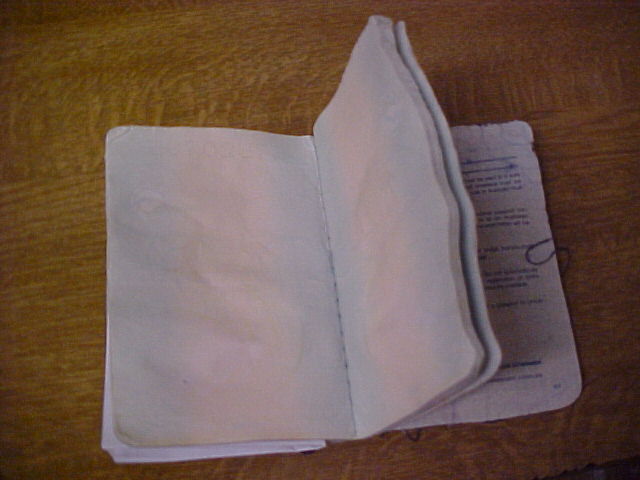
Synopsis: Accidentally putting passport in washing machine. (with trousers). Fortunately(?) flat's washing machine is not reliable and conked out 1/3rd the way through. Passport was quite mangled. Recovery involved slow and careful drying with tissue paper between each page (no heating in many(?) London flats - so putting near a radiator not an option - and might do harm(?)).
Advice Received: From several Dutch immigration officers while going in and out of The Netherlands on a work trip in December 2002 (and who had a good laugh at the passport). Overall summary was that a water damaged passports were still valid in their eyes as long as they are readable. Australian passports have the person's photograph digitally printed on the passport (not inserted). However, some countries (e.g., African) could give strife over a damaged passport, even if it was readable. You might only find this out the hard way.
Photocopy of Passport vs Birth Certificate: For getting a replacement passport (and filling in Australian Passport Application Form (Form PC8)), having the old damaged passport seems good enough if it is still readable. While some travel advice recommends having a photocopy of your passport stashed around you luggage and travel bag, if you have lost your passport, an original copy of a Birth Certificate seems to be required (and thus needs to travel with you). DFAT advises "also carry a copy of all your documentation somewhere else in your luggage." For Victorians, Birth Certificate's can be obtained on-line via Victorian Government - Registry of Births Deaths and Marriages via http://www.justice.vic.gov.au/bdm. Also, BDMAUS - Births, Deaths & Marriages Registries of Australasia is on-line at http://www.bdm.nsw.gov.au/bdmaus/.
Storing your passport vs carrying it with you: Referring to links to right: DFAT Living and Working overseas (Essential Information for the Australian Expatriate): http://www.dfat.gov.au/consular/download/working_overseas.pdf
- "All Australian citizens must have a valid passport before leaving Australia, and maintain a valid passport while overseas. Protect your passport - keep it at home in a safe, secure place. Although a passport stored outside the home in a bank deposit box might offer maximum security, it may be difficult or impossible to obtain your passport in time if you have an emergency requiring immediate travel."
Lachlan's (no doubt misinformed) comments: based on the relatively poor security against break-in's and theft in some rental and shared accomodation, leaving your passport in a locked draw or filing cabinet at work might be more secure(?). Especially if in shared accomodation that can have visitors for the other rentees. If neither work nor home offers a secure option for the passport: maybe always carrying the passport on your person might be the most secure(?) - in that if a passport theft occurs - it would be obvious that the passport had gone missing(?). The prudence of this could depend on the country and city you are living in. Having the passport safe on your person could help if you are not sure when you might need to show your passport as identification. Of the first person stories I have heard of stolen passports (not claiming to be statistically valid): half were stolen due to a break-in/theft at the rental accomodation (in the UK), the other half from street-mugging (in the US). While smallish amounts of money have gone missing in some rental accomodation, not leaving the passport at rental accomodation but in a locked filing cabinet (or carried personally) was possibly a good move.
Conventional wisdom seems to be that carrying your passport with you all the time is quite a foolish thing to do. However, my main reasoning would be that I am not sure when I might need the passport for identification. As a secondary consideration, it can be important to know when a passport has disappeared or been stolen. This state of relative enlightenment is more likely to happen if you carry it on your all the time (despite risk of putting it accidentally in the washing machine). If stored away at home or work "in a safe place": not being able to find it again (just before travelling) could mean the passport had been stolen some time before, or your memory of where you stored it could be faulty (which one?). Examples of the benefits of having a passport on your all the time: helping with unexpected legal/police or identity required situations: e.g., an early morning (Winter of 2000) police spot check while going home from the lab in Runcorn, Cheshire, England. And identification and legal requirements when working in the US (via Columbia University, New York webpage at http://www.columbia.edu/cu/isso/home2.html and another article at "Noncitizens Must Have Documents Verifying Their Status At All Times" by Cyrus D. Mehta and Parastou Hassouri ):
"There is a long-standing, little-known, and seldom enforced provision in the Immigration and Nationality Act that requires non-U.S. citizens over the age of 18 to carry with them evidence of what is known in the law as "alien registration". Pursuant to 8 C.F.R. § 264.1(b), the I-94 card would suffice as evidence of registration for those in F, J, H, O, P, and TN status. Not complying with this provision can lead to a $100 fine, 30 days imprisonment, or both. Even those of us with many years of experience in this field have never known this provision to be enforced. Recently, however, we have read of several instances in which the INS has invoked this requirement. Therefore, given the climate of heightened scrutiny we are advising that it would be prudent to carry your I-94 card with you. Be aware, however, that this insignificant looking card is actually the most important immigration document you have because it is the only legal evidence of the status in which you were admitted to the United States (an entry visa in your passport does not indicate how you entered the U.S.). Don’t lose it!
To travel by air - and increasingly by rail and bus - within the United States, one must present a government-issued photo ID. Although you are not required to carry a passport, for many who do not have a US driver’s license, a passport is often used for identification."
Well people may feel nervious about carrying around valuable documentation in New York. Some parts of New York state can be very safe to walk around at strange hours of the morning (e.g., the Lamont-Doherty Earth Observatory of Columbia University in Palisades, New York. Though keep an eye on the local lamont campus internet newsgroup about reports on wild "bears".)
Other links plus Obtaining a replacement Australian Passport in London via the Australian High Commission. Opening times (based on December 2002) for passports are 9:30am to 3:30pm, Monday to Friday. Passports entrance is the north side of the building. Standard issuing of a replacement Australian passport takes 10 working days but there is an express 48 hour process if great urgency is involved.
- Applying for a replacement passport: http://www.australia.org.uk/ausuk/html/replace.html
- Processing time for passport application in London: http://www.australia.org.uk/ausuk/html/time.html
- Applying for an emergency passport: http://www.australia.org.uk/ausuk/html/emergency.html
- Australian and consular passport services: http://www.australia.org.uk/ausuk/html/index.html
- The Australian High Commission in London will be closed on the following UK and Australian Public Holidays:: http://www.australia.org.uk/qna/html/holidays%20-%20AHC.html
- Passport Photo Tips: http://www.passports.gov.au/requirements/photos.html
- Renewal of Australian drivers' licences in London: http://www.australia.org.uk/ausuk/html/audrive.html
- Proof of Identity declaration for passport while in the UK: http://www.australia.org.uk/ausuk/html/id.html
- Embassies, High Commissions And Consulates in the UK: http://www.passports.gov.au/requirements/photos.html
- Consular Newsletter: http://www.dfat.gov.au/consular/newsletter/
- Australian High Commission, London, UK - opening times: http://www.australia.org.uk/ahc/html/index.html
- Australian Travel Advice: http://www.dfat.gov.au/consular/advice/advices_mnu.html
- Passports Australia:
http://www.passports.gov.au/
- DFAT Consular Newsletter NOVEMBER 2002 (Including: "Travel Scams - Don’t be paranoid, just be aware!"):
http://www.dfat.gov.au/consular/newsletter/ingeneral.html
- DFAT Travel information: http://www.dfat.gov.au/travel/
- DFAT Travel publications: http://www.dfat.gov.au/travel/order_brochure.html
Image
Description


- Front of resurrected water damaged passport
- Inside of resurrected water damaged passport (serial numbers blurred by computer software)