[IUCr Home Page] [Commission Home Page]
Daresbury Laboratory

CPD Logo


CPD News Index

Philips Advert
(www.analytical.philips.com)

Siefert Advert
(www.roentgenseifert.com)


Chairman's Message

Guest Editor's Comments

FP Workshop

XND Rietveld

BGMN FP Rietveld

Southampton Combined EXAFS-Rietveld

CFP - Oak Ridge Neutron Reactor

BEARTEX Texture

FP Line Profiles

BNL Workshop Report

CCP14

Micro Abs and Quant Analysis

Word Directory Powder Progs

ISPD 98 - India

Genetic Algs for Struc Sol'n

Rietica 95/LHPM - GUI Rietveld

Rietan

Solving Xtal Strucs

Powder Cell

50 Years of SD from PD

Line Profile and Rietveld

AXES

Memetic Algorithms

Evolving Algorithms

Fullprof/WinPlotr

Canadian PXRD Workshop Report

GUIs Using Tcl/Tk

Java in Crystallography

What's On

Call for Contributions - Next CPD Issue

Getting the CPD Newsletter Hardcopy Version

[IUCr-CPD Homepage | What's New | Newsletters | Projects | CCP14]

The IUCr-CPD Homepage is at http://www.iucr.org/iucr-top/comm/cpd/

Newsletter 20 - Summer 1998, Homepage


Rietica - A visual Rietveld program

Brett Hunter
Australian Nuclear Science and Technology Organisation PMB 1, Menai, N.S.W., 2234, Australia.
E-mail: bah@atom.ansto.gov.au;
WWW: http://www.anstro.gov.au

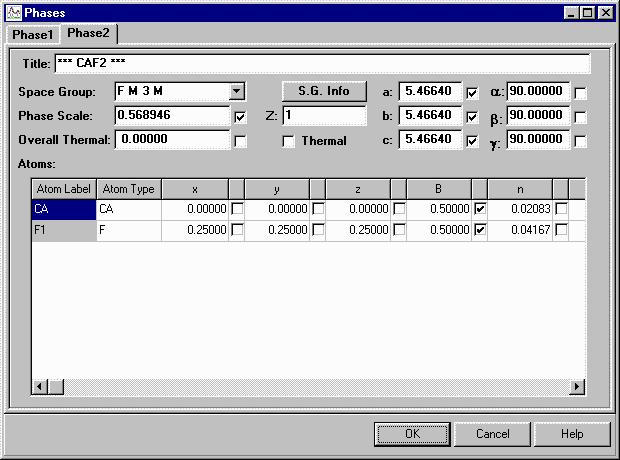
Rietica is a Rietveld program that allows interaction with the refinement process on a cycle by cycle basis using a graphic interface. The program is derived from the LHPM program which has its origins in the DWBS2.9/3.2 program of Wiles and Young, that in turn is a weak descendant of Rietveld’s original code and Alan Larsons space group code. Rietica was developed to aid in the creation and updating of the Rietveld input files, as well as to control the LHPM program. It is a Windows 95 based program allowing point and click control of all the functionality of LHPM.
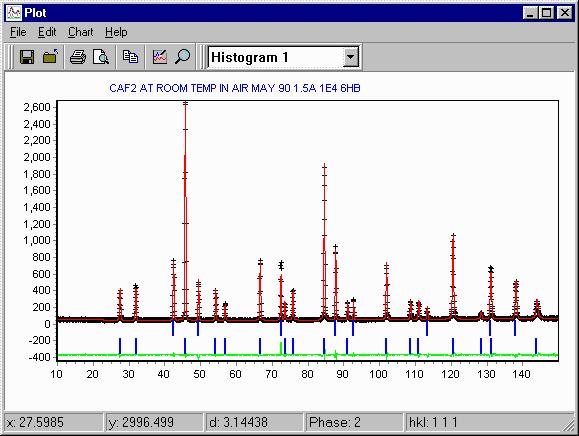
Fig 1. Display of Rietveld difference plot. Screen is zoomable and HKLs can be identified by clicking on them.

Some of the features of the Rietica program are:
  • multiple x-ray and/or neutron histograms (datasets) allowing different scales, zeros, peak profile types and values, backgrounds, wavelengths, preferred orientations for each histogram - all of which are refinable;
  • ability to calculate and refine neutron time-of-flight data;
  • each histogram can have it’s own scattering form factors/lengths, so can be used in anomalous scattering experiments. The ability to refine Df’ and Df’’ now allows extra flexibility with synchrotron diffraction data;
  • can interpolate x-ray form factors from a series of (sin(q)/l, f) values, so that any form factor profile can be used (such as a spherical Bessel function);
  • a new absorption correction formula allowing mR > 1.0 for cylindrical geometry and a flat plate absorption correction based surface roughness;
  • new background functions to deal with amorphous background contributions;
  • improved profile modeling, including anisotropic broadening and a TOF peak shape based on the Jorgensen peak shape;
  • quantitative phase analysis routines;
  • point and click data entry and program control;
  • data display and easy background and excluded region input via mouse control;
  • control of the refinement process, including automatic updating of the calculated pattern display after each step;
  • database storing and retrieval of structural data;
  • similar input files and data files can be grouped into projects;
  • can refine using 3 strategies:
    1. a point and click mode of data entry and refinement control (beginners/intermediate/advanced users)
    2. a manual editing of the input file, but still with all the benefits of the visual interface and online graphics (intermediate/advanced users). This mode is used for very quick changes to the input file, without clicking on multiple dialog boxes.
    3. a Basic scripting language that can be used to control the refinement process and graphics output. It could be used, say, for automatic refinement of large numbers of datasets (advanced users)

Fig 2. While manual editing of the ASCII control/input file is an option, all control and refinement options are accessible via GUI menus.

The program currently reads in LHPM and GSAS experiment files and other import and export facilities should be available soon. The online help explains the fundamentals of the Rietveld method, the layout of the program, the input file structure, and the visual interface.

The Rietveld method over the last several decades has enjoyed increasing success in the area of powder diffraction. Its success in part is due to the wide distribution of free source code and executables. In the same way Rietveld’s original philosophy benefited us, we freely distribute the back-end LHPM Fortran code with appropriate copyright notices.

(Editor's Note: LHPM-Rietica for Win95 can be downloaded off the internet at:
ftp://ftp.ansto.gov.au/pub/physics/neutron/rietveld/Rietica_LHPM95/

or via the CCP14 site

http://www.dl.ac.uk/CCP/CCP14/mirror/mirror.htm)


Newsletter 20 - Summer 1998, Homepage


[IUCr-CPD Homepage | What's New | Newsletters | Projects | CCP14]

Please feel free to email any queries to: r.j.cernik@dl.ac.uk