![[IUCr Home Page]](iucrhom2.gif)
![[Commission Home Page]](cpd.gif)
|
|
The IUCr-CPD Homepage is at http://www.iucr.org/iucr-top/comm/cpd/
50 Years of SDPD - Some StatisticsArmel. Le BailUniversité du Maine, Laboratoire des Fluorures, CNRS ESA 6010, Avenue O. Messiaen, 72085 Le Mans cedex 9, France. E-mail: armel@fluo.univ-lemans.fr WWW: http://fluo.univ-lemans.fr:8001/
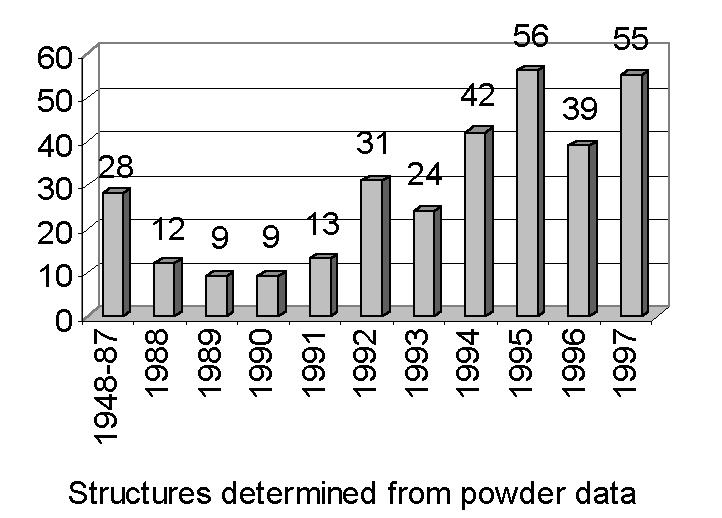 If we consider the UCl3 structure determination by Zachariasen [1] as the first structure determination from powder diffraction (SDPD) data, then it appears that 1998 is the SDPD jubilee. This may be the opportunity for some statistics, extracted from the SDPD-Database [2]. Uranium and plutonium-based compounds were the subject of 3 other powder studies, till 1968. We waited 1977 for the first modern SDPD by Berg and Werner, making use of computers for indexing (TREOR), applying the Patterson method to 120 integrated intensities (Guinier-Hägg film), locating 2 heavy (Mo) atoms, completing and refining the structure by successive Rietveld refinement and Fourier calculations. According to the current contents of the SDPD-Database, up to 1987, only 27 publications dealed with structure determination by powder diffractometry. The annual production in this early stage was ranging episodically from 0 to 4 papers maximum. During the year 1988, a peak occurred with 12 papers, then the annual production was more or less stable till 1992 showing a new expansion corresponding to 29 publications. The yearly production oscillated, with 22, 40, 55, 34 and finally 46 papers in 1997. These publication numbers correspond to slightly more structures determined (figure 1.). The jubilee coincides with exceeding 300 structure determinations (at least 318 structures described in 295 papers). These numbers are underestimated because some trivial and pre-Rietveld structures were not included in the databank. As many as 570 scientists are authors or co-authors of these 295 papers. Among them, 170 have signed 2 papers minimum, 41 have signed at least 5 and 17 at least 10 papers : these contributions attest for an increasing professionalism and give an idea of the mass of researchers motivated by solving structures in the absence of large enough single crystal. The two leaders (Clearfield and Poojary) have solved together 33 previously unknown structures. Obviously, SDPD was and remains hot topic since now 10 years. It is hard to say if the two abrupt variations in publication numbers (1988 and 1992) have some precise detonators. Possibly, following the Werner, Rossel, Noläng, Raveau, Smith and Clearfield early series of SDPDs, the 1988 peak could be due to a new series of 2 papers published then in Nature by Cheetham. Popularity and temperature of SDPD can be also measured by the number of review papers already published on the subject (33 references are gathered in the database). These reviews may provide different colors of SDPD, according to the authors main specialties. A complete list of experimental works, methods and softwares references would be larger than 500 and will not be given here ! The reader will find them in the SDPD - Database, including works involving structure redeterminations for the purpose of feasibility demonstration (20 papers). The most famous of these already known compounds is cimetidine, C10H16N6S, having long been given as the example of what could be done from synchrotron data (1991), with 17 non- hydrogen atoms located by direct methods. This limit was attained also in cases of previously unknown structures, even from conventional X-ray data, though it was not much outperformed. The 295 papers were found to be distributed in 51 periodicals of which 18 have published more than 5 SDPD, and 9 have published more than 10 SDPD. Two journals are largely heading: the Journal of Solid State Chemistry and the European Journal of Solid State and Inorganic Chemistry, with respectively 67 and 32 contributions. This tends to indicate the main kind of problem solved by powder diffraction, up to now. Indeed, only 31 organic, 63 organometallic and 8 polymers have been the subject of a SDPD. This may be considered as abnormal because of the almost reversed organic/inorganic 4/1 ratio in the Cambridge Structure Database (CSD) and in the Inorganic Crystal Structure Database (ICSD, excluding compounds with C-C bonds). Most of the 216 inorganic phases are oxides (159), the remaining being mainly halides (43) and intermetallics (12). Oxides based on tetrahedra building units represent 73 compounds in the group of phosphates, sulfates and arsenates, to which 17 silicates are to be added. The next well identified group being nitrates (12) mainly studied by Louër's group. Why these compounds were specially candidates for a SDPD is an interesting question. Most of them were obtained from syntheses conditions involving hydrothermal process at medium temperatures, unfavourable to the growing of sufficiently large single crystal, or dehydrations leading to unavoidable fragmentation. It is not risky to predict that the future will very probably see the reversal of the current 1/4 ratio in order to fit the 4/1 proportion of organic/inorganic compounds observed in the CSD/ICSD databanks. Arguments in this sense are found in the multiplication of methods allowing to locate molecules or known fragments. All crystal systems were the subject of SDPD, the monoclinic and orthorhombic systems being the more generally studied with respectively 42.4 and 30.1%. Instruments selected were traditionally either neutron reactors (65), synchrotron radiation sources (64) or in-laboratory conventional X-ray diffractometers with (94) or without (143) incident beam monochromator. In fact these numbers do no reflect the possible joint use of 2 or 3 of these instruments. Neutrons were used scarcely alone (22), many neutron cases correspond to studies of liquid-solid state phase transitions at low temperature (Fitch and Cockcroft). That the most complex structures will soon be solved from synchrotron data is evidence. We should first agree on what is a complex structure and define complexity criteria. Anyway, conventional X-rays have not really been outperformed yet by synchrotron radiation in quantity (237 and 64 applications, respectively) nor in quality (no real gap in complexity is observed, although it should be). Some times ago, it was stated that we were unable to determine structures as large as those we could refine by the Rietveld method. The new paradox is that we can locate now molecules in much bigger cells than we could refine without constraints. Due to resistance to change, habits listed in the SDPD-Database have chances to give us the tendencies for the years to come. Few softwares dominate each step of the SDPD whole process, they will probably extend their domination unless more efficient ones appear. Not all softwares are in the public domain so that some methods are the exclusivity of developers or teams repeating structure determinations by their own way. SDPD will not expand faster before a larger distribution of these new softwares. If your works is lacking in the database, please send the references (armel@fluo.univ lemans.fr).
Please feel free to email any queries to:
r.j.cernik@dl.ac.uk
|