![[IUCr Home Page]](iucrhom2.gif)
![[Commission Home Page]](cpd.gif)
|
|
The IUCr-CPD Homepage is at http://www.iucr.org/iucr-top/comm/cpd/
AXES - a software toolbox in powder diffractionHugo Mändar and Toivo VajakasDepartment of Physics, University of Tartu, 4 Tähe Str., EE2400 Tartu, Estonia. E-mail: hugo@physic.ut.ee
Introduction.Progress in powder X-ray diffraction has always been in high correlation with progress in developing of new algorithms, methods and computer programs for diffraction data processing. This paper gives an overview about the history and basic features of a program system AXES.
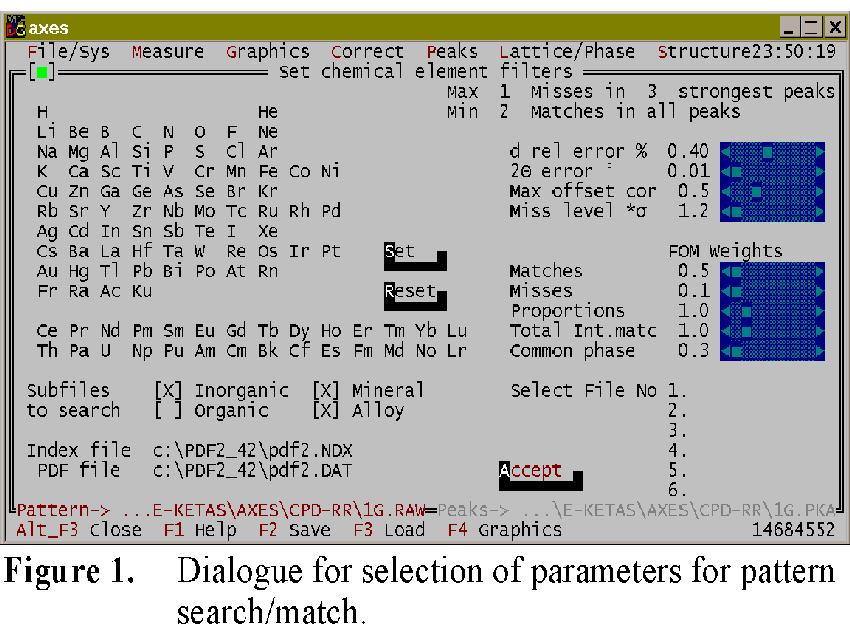
Historical backgroundDeveloping of AXES started in1992 in the framework of a cooperation between Universities of Konstanz (Germany) and Tartu (Estonia). The basic idea of the elaboration of our program was to get a user-friendly X-ray powder diffraction structure analysis package which includes available programs oriented for a single task and which can be used to perform a full route of analysis starting from data collection and finishing with structure visualization. This kind of program, called GUFI, was under development since 1987 in University of Heidelberg by Robert E. Dinnebier (Dinnebier, 1993). We selected GUFI (and its source language - Borland Pascal 6.0) as an initial platform and started to contribute to this project. Until 1994 the following programs and features were included or advanced:
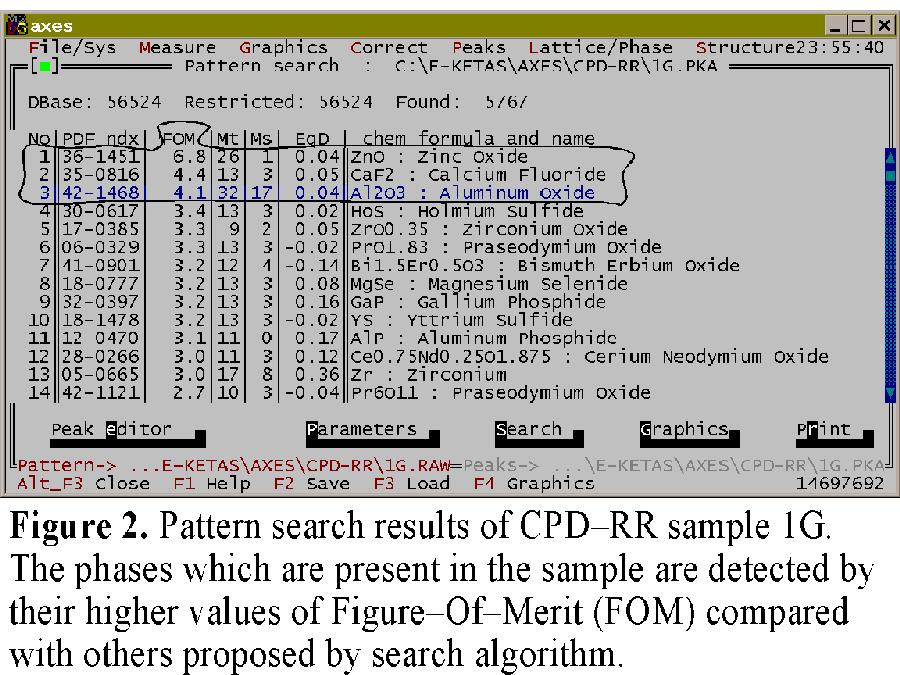
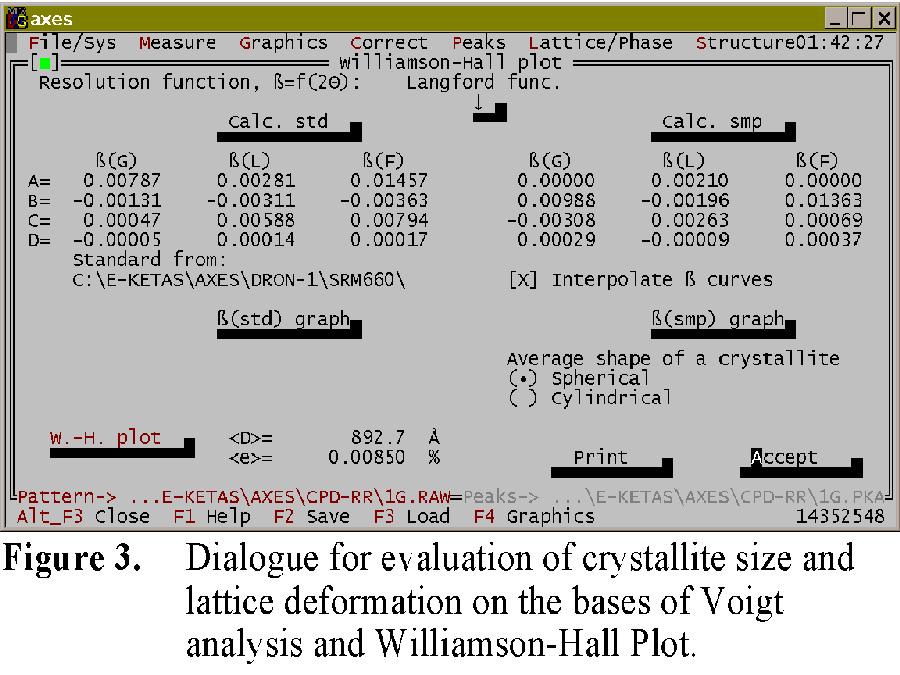 Commercialisation of GUFI in 1994 urged us to continue the project in a separate direction. The new program, after extracting the GUFI specific pattern processing dialogues and algorithms, and porting it to Pascal 7.0 with DPMI support, was called AXES. Since this time the following main tools have been included:
The source size of the program has grown more than three times containing now about 8200 lines. Full set of AXES tools is in form of compiled program available in a version A, which is distributed as shareware and requires a licence. A selected set of tools sufficient for diffraction data preprocessing, peak detection, fitting, indexing, cell refinement, crystallite size estimation and preparation of input files for Rietveld analysis is available free of charge in version B for education from ftp://ftp.physic.ut.ee/pub/pc/axes and the program suite CCP14. The current version of AXES 1.9 (including also the external programs and databases) should meet the needs both a professional crystallographer and a beginner in the field of powder diffraction.
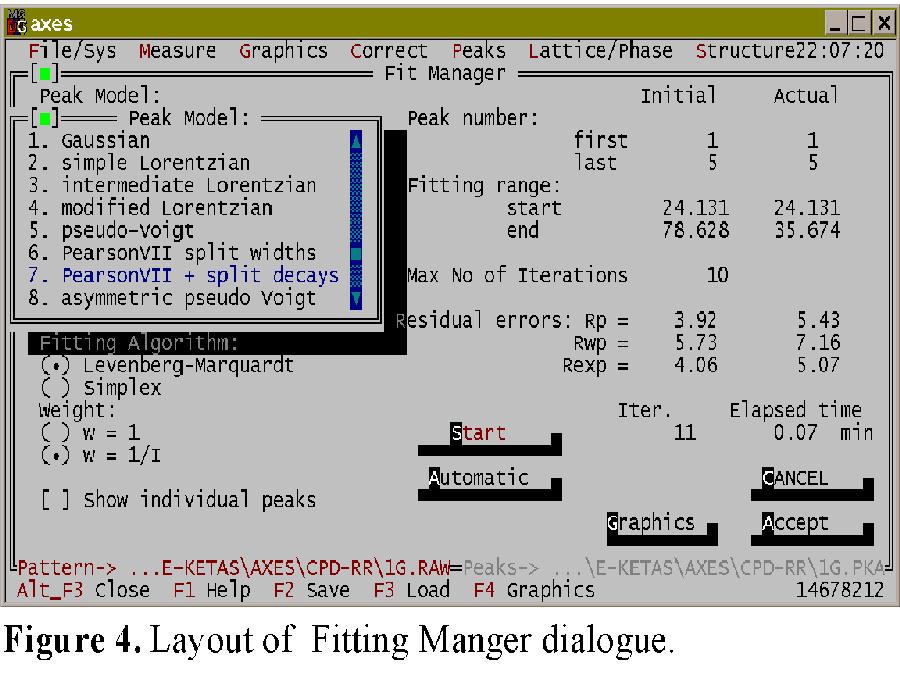
Example.The following example on the bases of the IUCr CPD Round Robin on Quantitative Phase Analysis sample No. 1G shows how AXES helps preparation of initial data for Rietveld analysis.From 27 different import/export formats of diffraction data available in AXES we use the Diffrac 3.x format to read in the pattern. For Rietveld program the pattern is saved in FULLPROF *.DAT format. Visual evaluation of background line gives often better estimates compared with analytical functions or Fourier filtering methods. Commands in dialogue Background Manual facilitate graphical detection of background curve which thereafter is saved in FULLPROF *.BAC format. Set of dialogues Pattern Fitting: Peak Parameters, WPPF
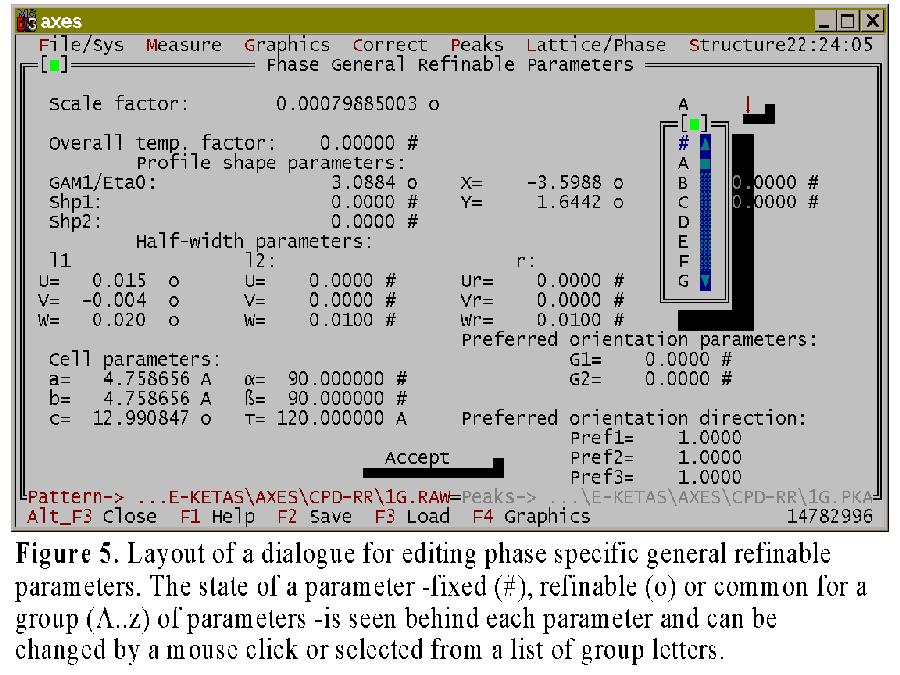 Parameters and Fit Manager (see Figure 4.) are used for calculation of initial values for peak shape parameters (u, v, w, m0). For a large number of peaks it is sufficient to fit peaks in three ranges - in the beginning, middle and end of the pattern, including 4-6 peaks in each range. A default fitting first with Gaussian and next with Pearson VII type function gives u=0.015, v=-0.004, w=0.020, m0=9. Now follows preparation of parameter files for Rietveld analysis. The shape parameters are entered in dialogue Phase Refinable General Parameters (see Figure 5.) of the FULLPROF *.PCR Editor. The other 19 dialogues of this set are used for preparation, inspecting and editing the refinement model of the sample. In case of structures containing many atoms in the unit cell, the user has a facility to import structure data from different sources: ICSD database, GSAS *.EXP file, input files of structure visualization programs (e.g. MolDraw, PowderCell).
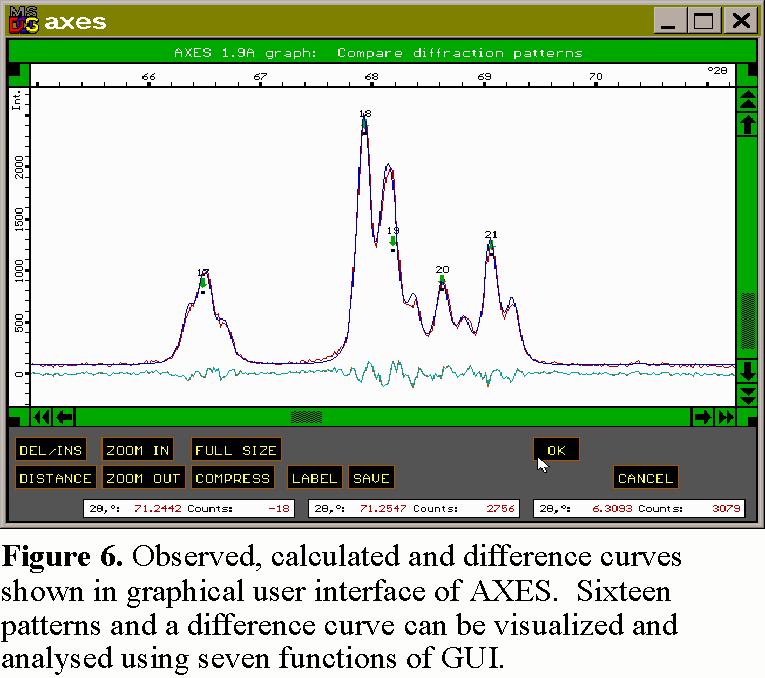 The most important facility of these dialogues is that in general, the user does not need to take care of counting, ordering and format of parameters (except the maximum number of refinable parameters which has to be given in Refin. Models dialogue), this is done by AXES. In case of complicated models, where the codewords are fractional, the user has to edit a *.PCR file directly. This can be done by a text editor accessible from inside the main dialogue of the *.PCR editor. Export and import of current set of parameters is done automatically by starting and finishing of FullProf. Fitting quality can now be assessed in graphics (see Figure 6.) using commands in dialogue Compare. The curves and marked points in the current graphics window can be saved into an ASCII file in x-y (an n column) format which is easily retrieved by any graphics drawing programs.
Perspectives.AXES is a MS DOS program but runs successfully in MS Windows. Perspectives of advancement are connected with porting it from DOS to Windows. Delphi had been selected as a new software platform and preliminary work was started in 1997.
References
Please feel free to email any queries to:
r.j.cernik@dl.ac.uk
|