![[IUCr Home Page]](iucrhom2.gif)
![[Commission Home Page]](cpd.gif)
|
|
The IUCr-CPD Homepage is at http://www.iucr.org/iucr-top/comm/cpd/
Recent Advances in the Rietveld-Analysis Program RietanFujio IzumiNational Institute for Research in Inorganic Materials, 1-1 Namiki, Tsukuba, Ibaraki 305-0044, Japan. E-mail: izumi@nirim.go.jp; WWW: http://www.nirim.go.jp/~izumi/ Five years have passed since RIETAN1) was introduced in the well-known book entitled "The Rietveld Method." RIETAN has a couple of versions for angle- dispersive diffraction and time-of-flight (TOF) neutron diffraction.2) It has been widely utilized particularly in Japan and Asia, contributing to a large number of structural studies. For example, the structures of the first superconducting copper oxides with fluorite and carbonate blocks were solved with RIETAN.3) This article reports some recent progress in RIETAN with emphasis on original technology.
1. Principle of partial profile relaxationThe profile function in Rietveld analysis generally contains two types of profile parameters: primary profile parameter (PPP) and secondary profile parameter (SPP). The dependence of PPP’s on q (angle-dispersive diffraction) or d (TOF neutron diffraction) is represented with physical foundations or in empirical ways to afford equations including SPP’s. For example, in the equation of Caglioti et al., Hk = (Utan2qk + Vtanqk + W)1/2, the full-width-at-half-maximum (FWHM), Hk, is a PPP specific for reflection k while U, V, and W are SPP’s common to the whole q (d) range. We refine not PPP’s but SPP’s in Rietveld analysis. Such equations impose a kind of equality constraints on PPP’s, sometimes failing to express relations between PPP’s and q (d) satisfactorily. As a PPP deviates from an equation relating it to q (d), the fit between observed and calculated profiles gets worse and worse. Such misfit gives rise to serial correlation committing a prerequisite of Gaussian distribution of residuals in least- squares methods. We have devised a new technique called partial profile relaxation,4) where the PPP’s of (nearly) isolated reflections specified by the user are locally refined independently of SPP’s. In Rietveld refinement with partial profile relaxation, PPP’s of these reflections are all or partially freed from equations relating PPP’s to q (d) and diffraction indices, hkl. On the other hand, peak positions and integrated intensities for the relaxed reflections are, respectively, calculated from lattice and structure parameters in the same fashion as those for the other reflections. Part of PPP’s may be constrained by the equations applied to reflections not to be relaxed. Though the profiles of only low-Q reflections can be substantially relaxed except for very simple structures, better fits in this region lead to improvements in fits in a high-Q region. Partial profile relaxation is especially suitable for samples showing anisotropic profile broadening. This technique is sound and powerful in the point that neither assumption nor approximation is required in regard to the dependence of PPP’s on q (d). We can even apply more flexible profile functions to relaxed reflections to improve the fit between observed and calculated patterns. In principle, profile relaxation can be introduced not only into Rietveld refinement but into Pawley refinement.
2. RIETAN for angle-dispersive diffractionWe have made it possible to analyze angle-dispersive diffraction data by the Rietveld method under partial profile relaxation5) with split-type pseudo-Voigt and Pearson VII profile functions.6) On the use of the former function, a modified split-type pseudo-Voigt function, where the FWHM’s of Gaussian and Lorentzian components differ from each other, can be fit to observed profiles of relaxed reflections.
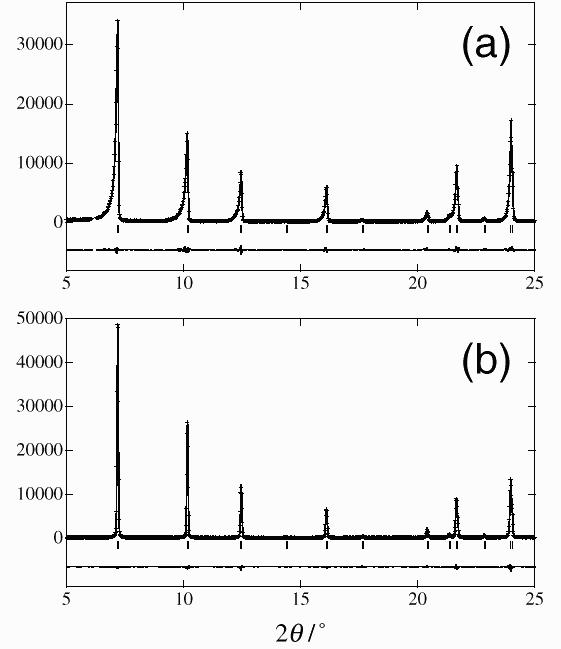 Fig. 1 Observed (plus marks), calculated (solid line), and difference (bottom) patterns of Na-LTA in a low-2q region. X-Ray diffraction data were measured with a pair of Soller slits having angular apertures of (a) 58 and (b) 18. Partial profile relaxation proved to be very effective for analyzing intensity data including highly asymmetric reflections in low-2q regions. Profile asymmetry, particularly pronounced in the Bragg-Brentano parafocusing geometry and constant-wavelength neutron diffraction, may be inadequately approximated with symmetric profile functions made asymmetric by various procedures. In particular, flat-specimen and specimen-transparency errors in the parafocusing geometry are difficult to represent analytically. With profile-relaxed Rietveld refinement, we have been successfully analyzing the crystal structures of various zeolites which exhibit reflections in 2q regions lower than 208. Figure 1 exemplifies part of Rietveld- refinement patterns for a zeolite, hydrated Na-LTA (Linde Type A), whose X-ray diffraction data were measured with CuKa radiation and two different goniometers.5) Other new features implemented in the latest version5) are
The last item will be described separately in the next section. 3. MEM-based visualization and fitting of diffraction patternsRIETAN has recently been combined with MEED7) to form a joint software named REMEDY.8) After Rietveld analysis, ‘observed’ structure factors, Fo’s, are evaluated by partitioning observed intensities among overlapping reflections in proportion to their profiles calculated from final parameters in Rietveld analysis. These Fo’s are analyzed by the MEM to give three-dimensional electron or nuclear densities, which are more or less biased by a structural model in Rietveld analysis. We can, however, extract structural details from the Fo’s by the model-free MEM because the Fo’s contain contributions that have not been taken into account in the structural model.
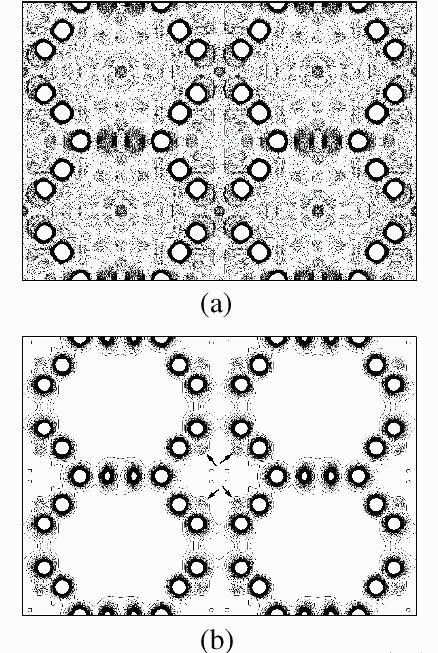 Fig. 2 Electron-density distribution on the (110) section determined for dehydrated Na-LTA by (a) Fourier synthesis and (b) MEM analysis with the same number of Fo’s. The vertical axis is parallel to the c axis. Low peaks pointed by arrows in (b) denote residual water in a b-cage. The visualization of diffraction data by the MEM is very useful for modifying structural models imperfect with respect to positional disorder, defects, and partially occupied sites. Figure 2 shows electron-density maps on the (110) plane obtained by (a) Fourier synthesis and (b) MEM analysis for Na-LTA dehydrated imperfectly.9) The termination effect makes it nearly impossible to distinguish between residual water molecules and ripples in (a). By contrast, residual water can be clearly seen in (b) at four positions inside the b-cage despite an occupancy as low as 0.028. REMEDY is, furthermore, capable of evaluating structure factors, Fc(MEM)’s, by Fourier synthesis of three- dimensional electron/nuclear densities. We can fit the powder pattern calculated from the Fc(MEM)’s to the whole observed one in order to refine parameters other than structure parameters. Fo’s obtained after the whole pattern fitting according to the procedure described above are analyzed again by the MEM. The pattern fitting and MEM analysis are alternately repeated in this manner until R factors in the pattern fitting no longer decrease. The influence of the structure model on Fo’s diminishes with increasing number of iterations. This combined method is expected to model covalent bondings and disordered atomic arrangements more satisfactorily than the conventional Rietveld method. Work is now under way to improve the MEM part of REMEDY further and make integration of RIETAN and MEED more seamless. 4. RIETAN for TOF neutron powder diffractionSince 1993, we have been operating a TOF neutron powder diffractometer, Vega,10) at the KENS pulsed neutron source in place of the preceding one, HRP. In our previous version of RIETAN for TOF neutron diffraction, we adopted a flexible profile function optimized for HRP, i.e., linear combination of two Cole-Windsor functions in a (1-R):R ratio.2) This profile function was modified for Vega in such a way that the leading part is approximated by a pseudo-Voigt function containing three PPP’s, s0, s1, and h. We determined the dependence of seven PPP’s (s0, s1, h, g1, g2, and R) in the new profile function on d. The resulting seven equations including 18 secondary profile parameters were substituted in the new profile function, which was then incorporated in our Rietveld-analysis program for Vega.4)
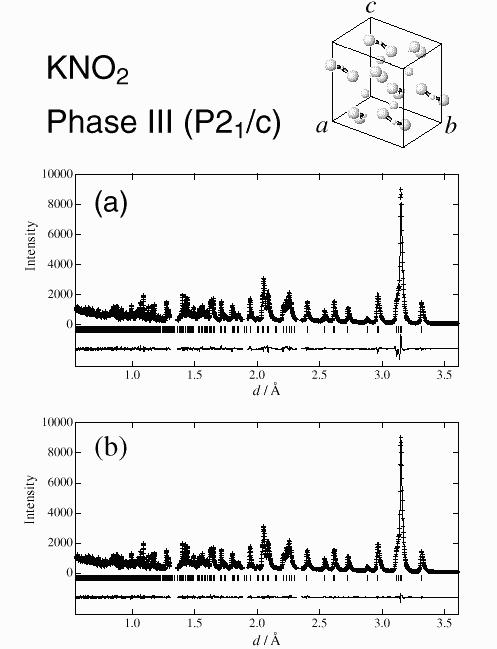 Fig. 3 Results of (a) conventional and (b) profile-relaxed Rietveld refinements for KNO2 (phase III) at 4 K. RIETAN for TOF neutron diffraction shares various advanced features with the angle-dispersive version. Partial profile relaxation is also applicable to intensity data taken on Vega. Figure 3 demonstrates a most dramatic improvement in a fit by applying this technique to phase III for KNO2.11) When PPP's of ten reflections were relaxed to be varied directly, the goodness-of-fit indicator, S, decreased drastically from 1.63 to 1.17. We plan to adapt RIETAN for a high-resolution powder diffractometer, Sirius, that has recently been installed at the KENS. We will be able to optimize a profile function for Sirius only by changing PPP vs. d relations. References
Please feel free to email any queries to:
r.j.cernik@dl.ac.uk
|